Figure template · Workflow · 4:3
Multi-Agent Workflow for Promoting Research Papers
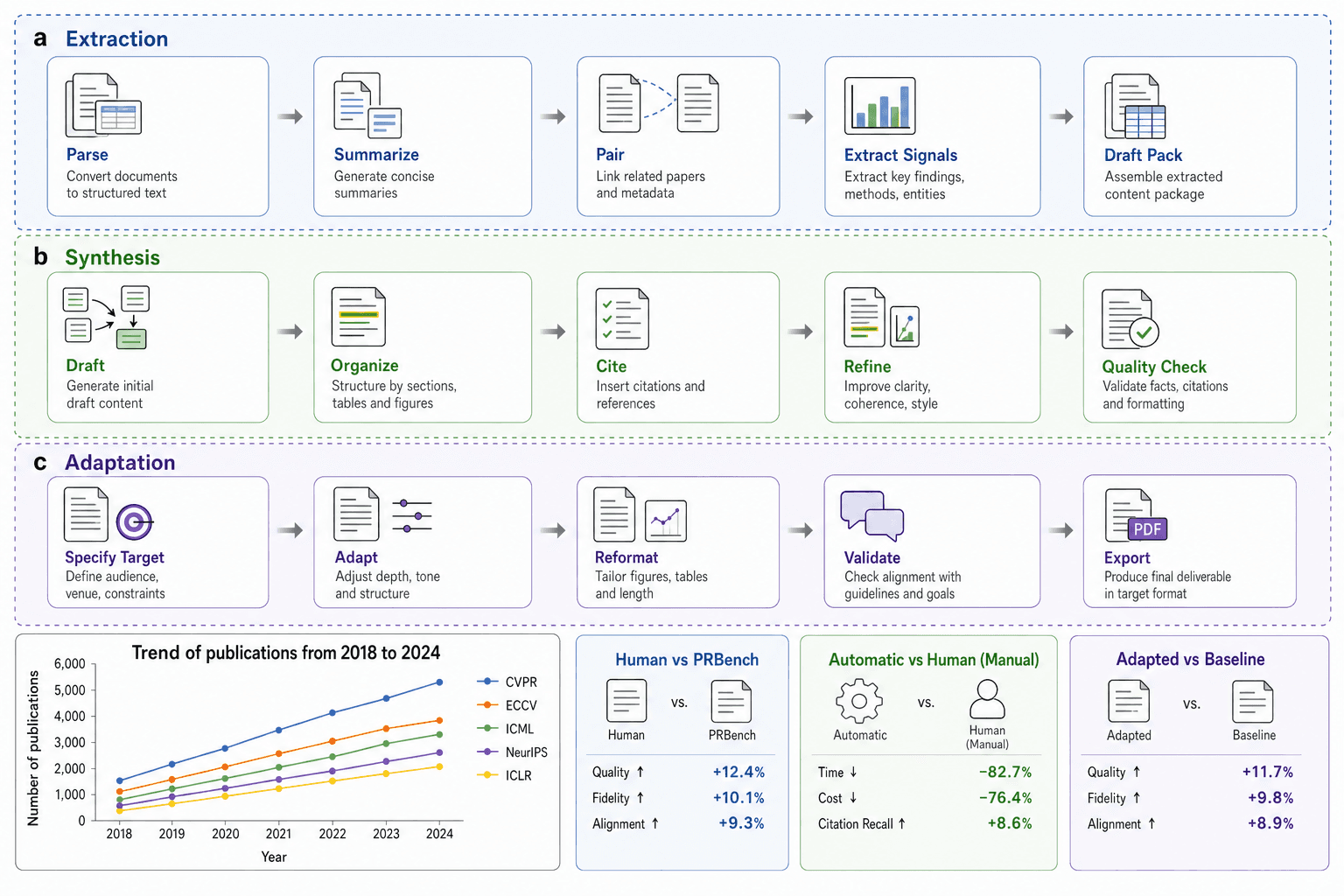
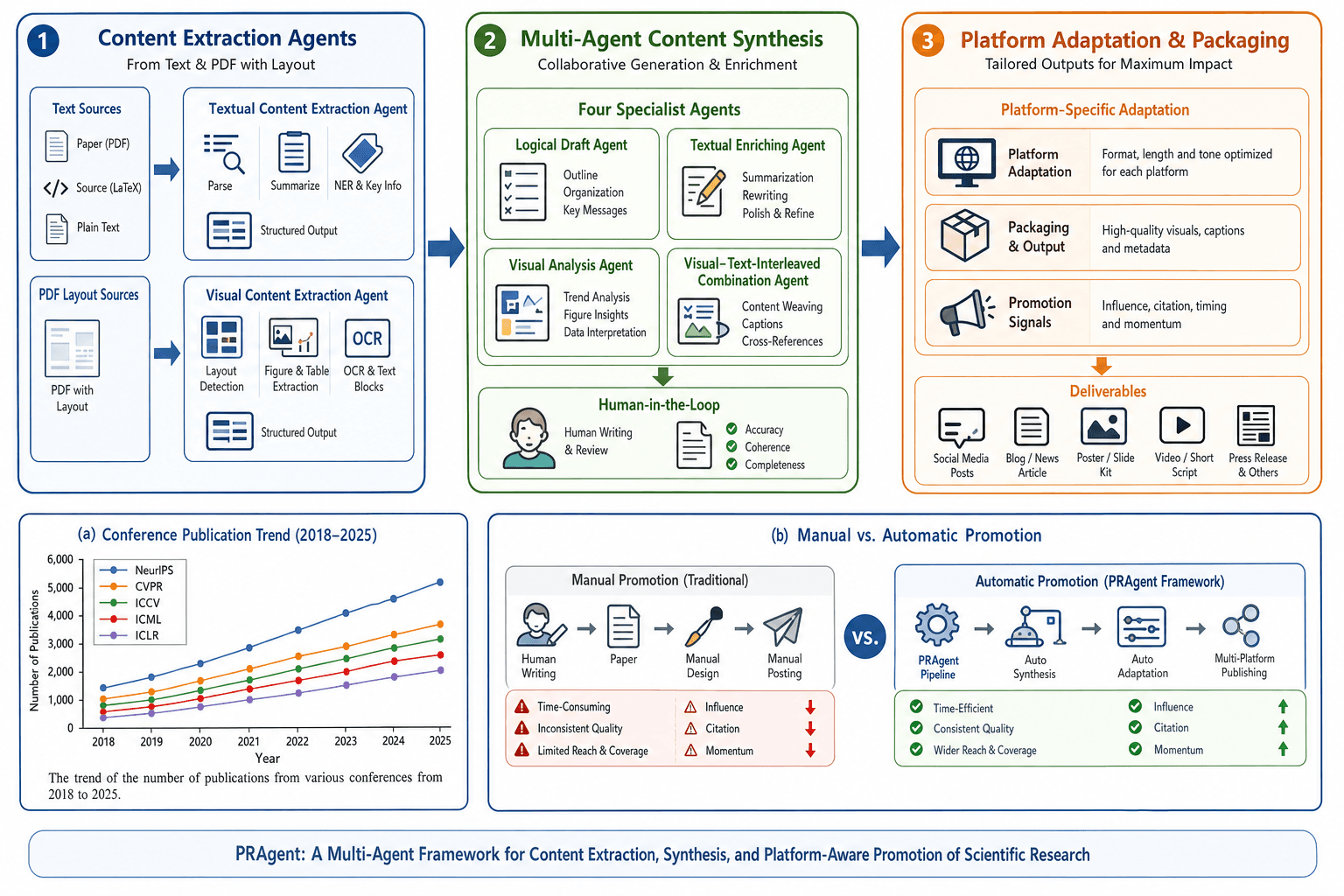
Three numbered panels in blue, green and orange carry a paper from extraction to platform-ready deliverables, while a trend chart and a manual-versus-automatic comparison underneath make the motivation. Suited to LLM agent and science communication papers.
Prompt
Create a scientific figure about: Paper-promotion agents from extraction to packaging. Visual style: Clean Vector. Requirements: publication-ready scientific quality, clear labels and directional arrows where appropriate, avoid cartoon or stock-photo look, composition optimized for research papers and academic slides.
What this template is
The figure describes a multi-agent framework that turns a research paper into promotional material for several platforms. Stage one parses text, layout, figures and tables from the PDF, LaTeX source or plain text. Stage two hands the extracted content to four specialist agents, covering logical drafting, textual enrichment, visual analysis and interleaved figure-text combination, followed by human review. Stage three adapts format, length and tone per platform and packages social media posts, blog articles, poster or slide kits, short video scripts and press releases. A reader should be able to name each stage's input, output and the point where a person steps in.
Elements to label
Text and layout sources
Two source boxes at top left: paper PDF, LaTeX source and plain text, and a PDF with its page layout preserved.
Two extraction agents
The textual agent parses, summarizes and tags entities; the visual agent detects layout, extracts figures and tables and runs OCR.
Four specialist agents
A green grid of four cards, each naming its agent and three duties, from outlining to cross-references.
Human-in-the-loop review
A person icon labelled human writing and review, with ticks for accuracy, coherence and completeness.
Platform adaptation block
Orange rows for platform adaptation, packaging and output, and promotion signals, each with a one-line goal.
Deliverable icons
Five icons along the bottom of stage three; trim them to the platforms your system really targets.
Publication trend chart
Panel (a) plots yearly publication counts for several venues; label the axis units and cite the data source.
Manual versus automatic panel
Panel (b) sets a human-driven chain beside an automated one, contrasting time, quality, reach and impact.
Where it is used
- Paper mechanism figure
- Defense slides
- Academic poster
- Lab website
What reviewers look for
Source of the trend data
The publication counts in panel (a) are illustrative, yet the chart names specific venues and years. Replace them with verifiable statistics and cite where they come from, or remove the panel and make the motivation in the text.
Where human review sits
Review is attached only below the synthesis stage. Reviewers will ask whether anyone checks the packaged output before it is posted, which stage a rejected draft returns to, and how much editing a person typically does.
Measuring promotion impact
Panel (b) shows influence, citations and momentum only as up or down arrows. Expect requests for the actual engagement metrics, the baseline you compare against and the evaluation protocol behind those claims.
Hand-off between agents
Each extraction agent emits its own structured output, but the figure never shows how the synthesis agents merge them or resolve conflicts. Naming the intermediate representation and its fields makes the method reproducible.
How to use it in Yila
- 1Pick a figure
- 2Describe your subject and the steps to stress
- 3Refine it in chat, then download the PNG
Tips
Do
- Replace the framework name in the bottom banner with your own system's name, and summarize the three stages in one caption sentence.
- Note the model or prompting strategy beside each specialist agent so reviewers can follow the method.
- Keep the stage colours blue, green and orange consistent if you reuse them in later result or ablation figures.
Avoid
- Leaving the sample venue names and publication counts in place; they are not real statistics.
- Relying on arrows alone in the comparison panel, since a contrast without metrics persuades nobody.
- Shrinking the figure to a single column, where the small agent-duty text and deliverable labels become unreadable.
Questions
Can this workflow figure go straight into my paper?
Use it as a draft of your framework figure. It is an AI-generated illustration, and its trend chart, venue names and framework title are examples. Swap in your system's name, real data and the modules you actually built before you submit.
Can I change the number of agents or what each one does?
The image is not editable element by element and is not a vector graphic. Keep chatting in Yila instead, for example merge two specialist agents or add a fact-checking agent after synthesis, and the whole workflow is regenerated from your description.
What format is delivered?
An AI-generated PNG image in a 4:3 landscape frame. The upper panels hold dense text, so give the figure the full page width in a two-column layout; if the venue wants vector art, redraw it in a diagramming tool following the three-stage structure.
Is it free?
Viewing this page and the sample costs nothing. Generating the figure in Yila, and each later revision, consumes credits. New accounts receive 2,500 credits, enough to produce the framework figure and refine stage names and deliverables over several rounds.
Can I drop the two lower panels and keep only the pipeline?
Yes. Ask Yila to draw the three stages and the deliverables alone. The layout opens up, the text can be set larger, and it reads well on a defense slide or poster, while trend and comparison data are better shown as real charts in the results section.
Does the layout suit other content-generation agents?
The extract, synthesize and adapt structure also fits systems that draft patent summaries, teaching materials or project reports from source documents. Describe your own inputs, agents and outputs in the chat, and the three-stage arrangement with its colour coding can stay as it is.