Figure template · System & Network · 4:3
Sequence Atlas with Cluster Enrichment and Domains
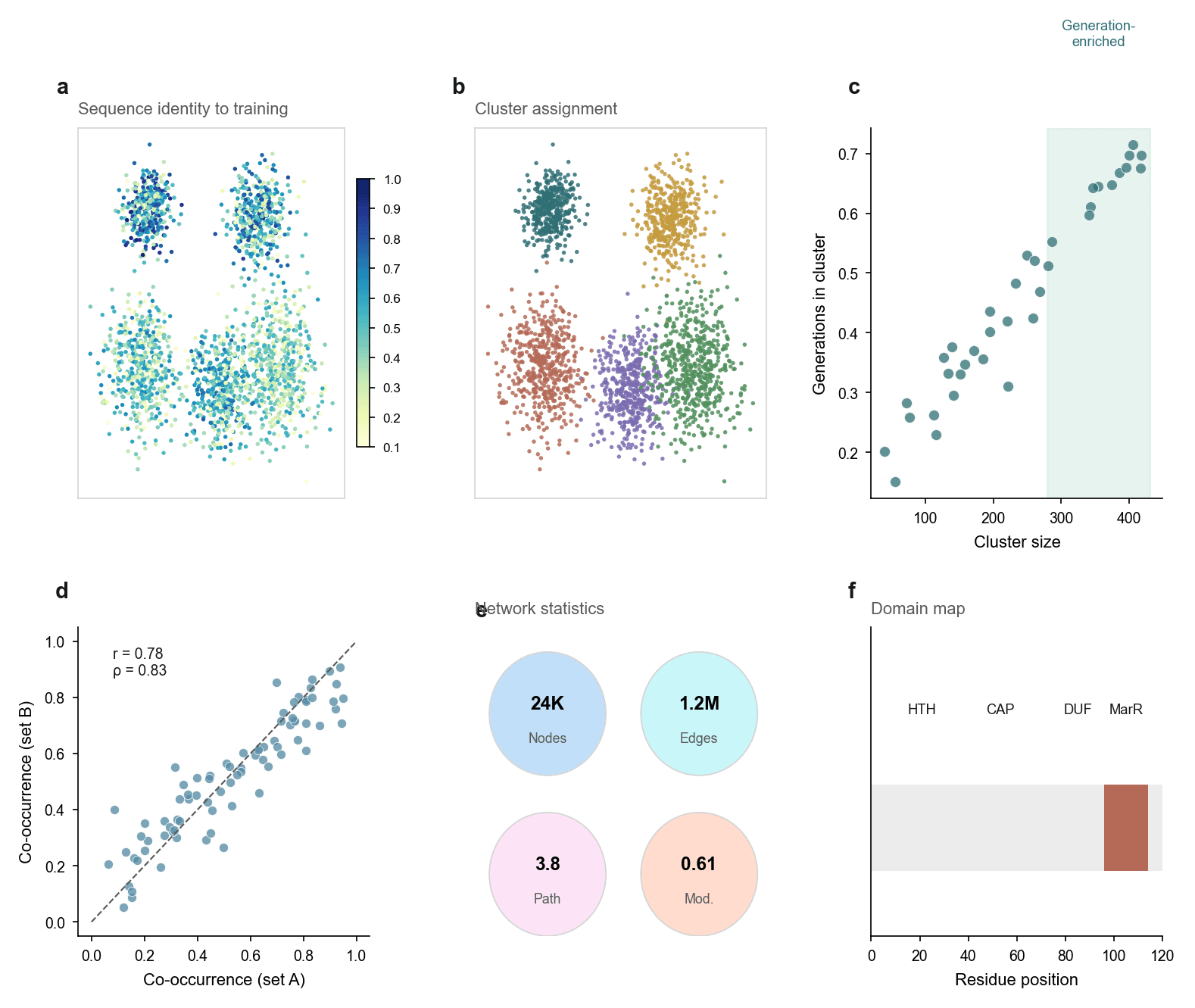
Two embedding panels show the same sequences coloured first by identity to the training set and then by cluster, followed by a cluster size trend, a co-occurrence agreement plot, network statistics and a residue-level domain map.
Prompt
Create a scientific figure about: Sequence atlas with cluster enrichment and domain maps. Visual style: Clean Vector. Requirements: publication-ready scientific quality, clear labels and directional arrows where appropriate, avoid cartoon or stock-photo look, composition optimized for research papers and academic slides.
What this template is
The page asks where generated sequences land in sequence space. Two scatter panels on shared coordinates let a reader look at the same points twice, once by similarity to the training set and once by cluster membership, which is the comparison the whole figure rests on. A third panel tests whether larger clusters hold a larger share of generated sequences. Beneath them, a co-occurrence agreement plot, a block of network statistics and a residue-level domain map say what those clusters mean in terms of network structure and protein architecture.
Elements to label
Identity-coloured embedding
Panel a colours each point by its sequence identity to the training set, with a continuous colour bar beside it.
Cluster-coloured embedding
Panel b reuses exactly the same coordinates with one colour per cluster, matching the clusters used downstream.
Cluster size trend
Panel c plots cluster size against the share of generated sequences, with a shaded band marking the enriched range.
Co-occurrence agreement
Panel d plots one set against the other with a diagonal for perfect agreement and correlation coefficients in the corner.
Network statistics
Panel e holds four circles giving the node and edge counts, the mean path length and modularity, each named below.
Domain map
Panel f runs along residue position: a grey bar for the full length, with coloured blocks for the annotated domains.
Enrichment note
A short line at the top right states that the shaded range marks generation-enriched clusters, tying it to panel c.
Where it is used
- Paper mechanism figure
- Graphical abstract
- Defense slides
- Lab website
What reviewers look for
The domain map is misaligned
The grey full-length bar starts left of the axis origin and none of the four domain names sits over its coloured block, so no residue range can be read off. Align the bar to the axis and place every label on its own block.
Cluster counts must match
The clusters coloured in the upper panel and those referenced by the network analysis have to be the same set of clusters. If two clustering runs were used, the caption must say so, or readers will assume one.
Identity versus cluster is unanswered
The same points are coloured twice, yet nothing states whether the low-identity sequences concentrate in particular clusters. That is precisely the conclusion a reviewer looks for, so it belongs in the text or in the caption.
Name the correlation measures
Two coefficients sit in the corner of the agreement panel without saying which is rank-based, or whether the unit is a sequence pair or a cluster pair. Both are needed to read that diagonal.
How to use it in Yila
- 1Pick a figure
- 2Describe your subject and the steps to stress
- 3Refine it in chat, then download the PNG
Tips
Do
- Keep the two embedding panels on identical ranges and point sizes so identity and cluster can be overlaid mentally.
- Replace the circled network numbers with your own, and state in the caption which threshold was used to build the network.
- Colour only the domains your argument needs and leave the rest of the bar grey rather than filling it end to end.
Avoid
- Do not let panel letters overlap the titles beside them, as happens in a few places here and worsens when reduced.
- Do not use two different palettes for the clusters and the domains without legends; readers will read one colour as one meaning.
Questions
Can this go straight into a paper?
Treat it as a layout reference for a dense multi-panel figure. The scatter points, correlation values, network counts and domain positions are AI-generated illustration, so substitute your own results, and fix the misaligned domain bar and the overlapping panel letters before anything is submitted.
Can elements in the figure be changed?
Not element by element, but you can keep refining it by chatting in Yila: rename the dimensionality reduction, change the number of clusters, turn the statistics circles into a small table, drop the agreement panel, or keep only the top row of three, then generate a new version from that description.
What format is delivered?
An AI-generated PNG image in a 4:3 landscape layout. It is not a vector graphic, and with six panels on one page the colour bar ticks and domain names soften when reduced, so view it at column width before deciding whether to split it into two figures.
Is it free?
Viewing this page and the sample figure costs nothing. Generating a version in Yila consumes credits, and a new account receives 2,500 credits, which is enough to adjust the panel count, the palette and the domain annotation until the whole page fits your own dataset.
I work on a small-molecule library rather than protein sequences. Does it fit?
Yes. Turn the two embeddings into chemical space projections and replace the domain map with a scaffold or functional-group distribution along the molecule. The cluster size trend, the agreement plot and the statistics circles all carry over to that data unchanged.
Can I keep only the top row?
Ask for the two embeddings and the cluster size trend alone, with the lower three panels removed entirely. A single row of three reads well on a defense slide, where one screen then carries one conclusion about how the sequences are distributed.