Figure template · System & Network · 4:3
Metabolic Map Linking Glycolysis and the TCA Cycle
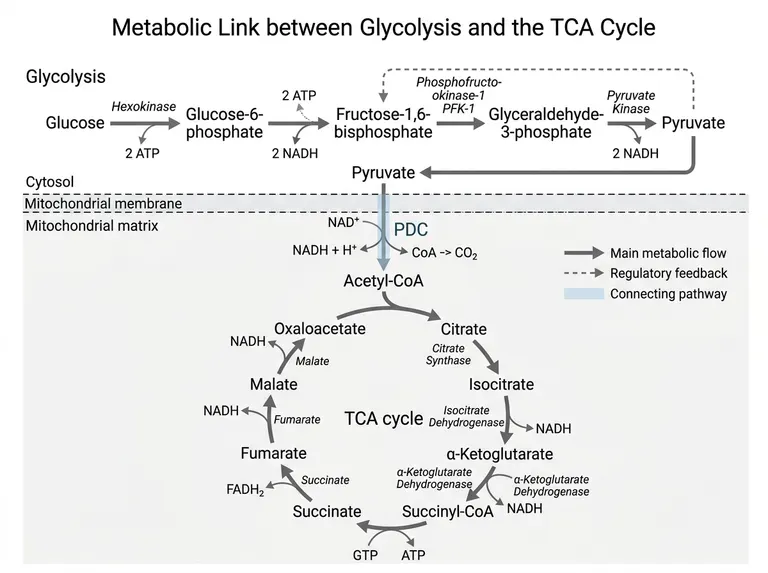
A landscape metabolic figure in two tiers, glycolysis across the cytosol above and the TCA cycle in the mitochondrial matrix below, joined by the pyruvate dehydrogenase complex at the membrane, for metabolism papers and biochemistry handouts.
Prompt
Create a scientific figure about: Metabolic network map linking glycolysis and the TCA cycle. Visual style: Clean Vector. Requirements: publication-ready scientific quality, clear labels and directional arrows where appropriate, avoid cartoon or stock-photo look, composition optimized for research papers and academic slides.
What this template is
Glucose runs left to right through hexokinase, phosphofructokinase-1 and pyruvate kinase to pyruvate. Pyruvate crosses into the mitochondrion, where the pyruvate dehydrogenase complex decarboxylates it to acetyl-CoA, reducing NAD+ to NADH. Acetyl-CoA condenses with oxaloacetate to form citrate, and the cycle turns through isocitrate, α-ketoglutarate, succinyl-CoA, succinate, fumarate and malate back to oxaloacetate, releasing NADH, FADH2 and GTP along the way. A reader should be able to point to the steps that generate reducing equivalents and to the single junction where the two pathways meet.
Elements to label
Compartment boundaries
Dashed lines separate cytosol, mitochondrial membrane and matrix, with the direction of pyruvate transport marked where it crosses.
Glycolytic backbone
Glucose to pyruvate in one row; the sample skips fructose-6-phosphate and several intermediate steps, which you may want restored.
Regulatory enzymes
Hexokinase, phosphofructokinase-1 and pyruvate kinase written on the arrows they catalyse; one is misplaced in the sample.
Pyruvate dehydrogenase complex
Straddling the membrane band, with NAD+ and CoA going in and NADH and CO2 coming out.
Acetyl-CoA entry
Condensing with oxaloacetate to give citrate, with citrate synthase labelled on that step and nowhere else.
TCA cycle intermediates
Eight intermediates clockwise with enzyme names inside the ring; the sample puts substrate names where several enzymes should be.
Reducing equivalents and energy
NADH, FADH2 and GTP leave on small curved arrows, placed only at the steps that actually produce them.
Legend
A key on the right separating main metabolic flow, regulatory feedback and the connecting pathway, each with its own line style.
Where it is used
- Course handout
- Paper mechanism figure
- Defense slides
- Academic poster
What reviewers look for
The ATP accounting is wrong
The sample shows hexokinase yielding 2 ATP, when the step consumes one, and gives pyruvate kinase an NADH output when it actually makes ATP. A biochemistry reviewer will catch both at once.
Enzymes on the wrong steps
Phosphofructokinase-1 sits on the cleavage after fructose bisphosphate, and citrate synthase on the arrow from citrate to isocitrate, which belongs to aconitase. Move both back to the reactions they catalyse.
Fumarate to malate makes no NADH
Fumarase only adds water, yet the sample draws NADH at that step. In the cycle NADH comes from exactly three dehydrogenations: isocitrate, α-ketoglutarate and malate, while succinate dehydrogenase gives FADH2.
The feedback arrow runs backwards
A dashed arrow loops from pyruvate back to fructose bisphosphate. The textbook control is feed-forward activation of pyruvate kinase by fructose bisphosphate, so the direction and meaning both need fixing.
How to use it in Yila
- 1Pick a figure
- 2Describe your subject and the steps to stress
- 3Refine it in chat, then download the PNG
Tips
Do
- Name the branches you care about, such as lactate, glutamine anaplerosis or the pentose phosphate pathway, so the figure becomes a real network.
- If you have isotope tracing data, ask Yila to colour the intermediates that carry labelled carbon so the map matches your mass spectrometry.
- Ask for the missing glycolytic intermediates and aconitase if the figure will teach the pathway step by step.
Avoid
- Do not copy the cofactor bookkeeping from the sample; check every ATP and NADH against a textbook after each round.
- Do not set enzymes and metabolites in the same type; italic enzyme names beside the arrows keep the two apart.
Questions
Can I use this map directly in a paper or lecture?
Not without corrections. It is an AI-generated image whose ATP and NADH accounting is wrong in several places and whose phosphofructokinase and citrate synthase labels sit on the wrong steps. Check it step by step, fix the errors by chatting in Yila, and only then put it in a paper or handout.
Can I change the metabolites and enzymes in the figure?
Not element by element, but you can keep refining it by chatting in Yila. Say which cofactor or enzyme label is wrong at which step, or which intermediates to add, and it will regenerate the whole figure from your description.
What format is delivered?
An AI-generated PNG image in a 4:3 landscape frame, suited to slides and handouts. It is not a vector graphic, and cofactor subscripts and superscripts are small, so check that labels such as NAD+ and FADH2 stay clear before enlarging or printing.
Do I pay to generate my version?
Browsing this page and the sample costs nothing. Generating and editing in Yila consumes credits, and a new account receives 2,500 credits, enough to correct this map over a few rounds and add your own metabolic branches, such as the lactate or glutamine routes your data cover.
Can it show aerobic glycolysis in tumour cells?
Yes. Ask for a thick arrow from pyruvate to lactate labelled with lactate dehydrogenase and a thinner arrow into the mitochondrion, and the figure will express the Warburg shift away from oxidation that your cancer metabolism story needs. You can also ask for the lactate exporter at the plasma membrane.
Can fatty acid and amino acid entry points be added?
Yes. Name the inputs you need, for example beta-oxidation feeding acetyl-CoA or glutamine entering as α-ketoglutarate through glutamate, and it will attach those branches at the right positions on the cycle. Adding them is also what turns this linear chain into the network its title promises.