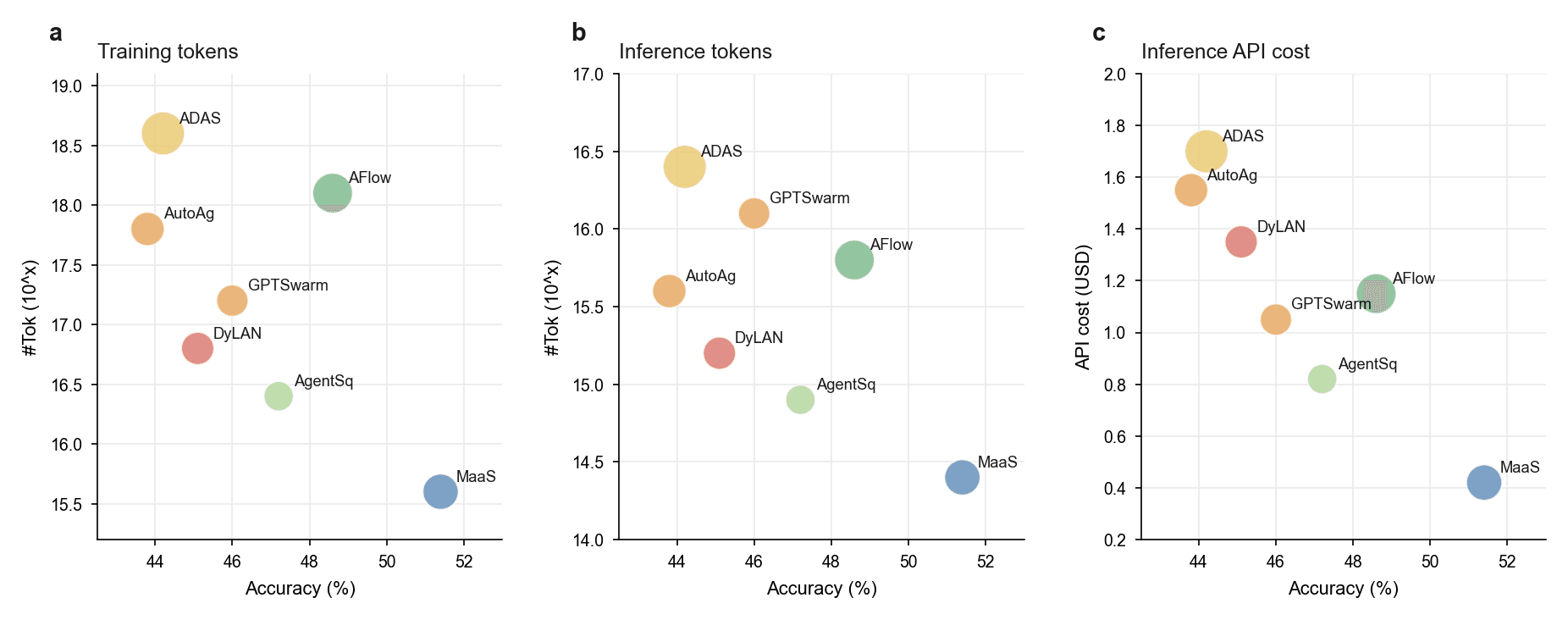
Figure template · System & Network · 4:3
Encoder, Reasoner and Decoder with Cross-Scale Skip Paths
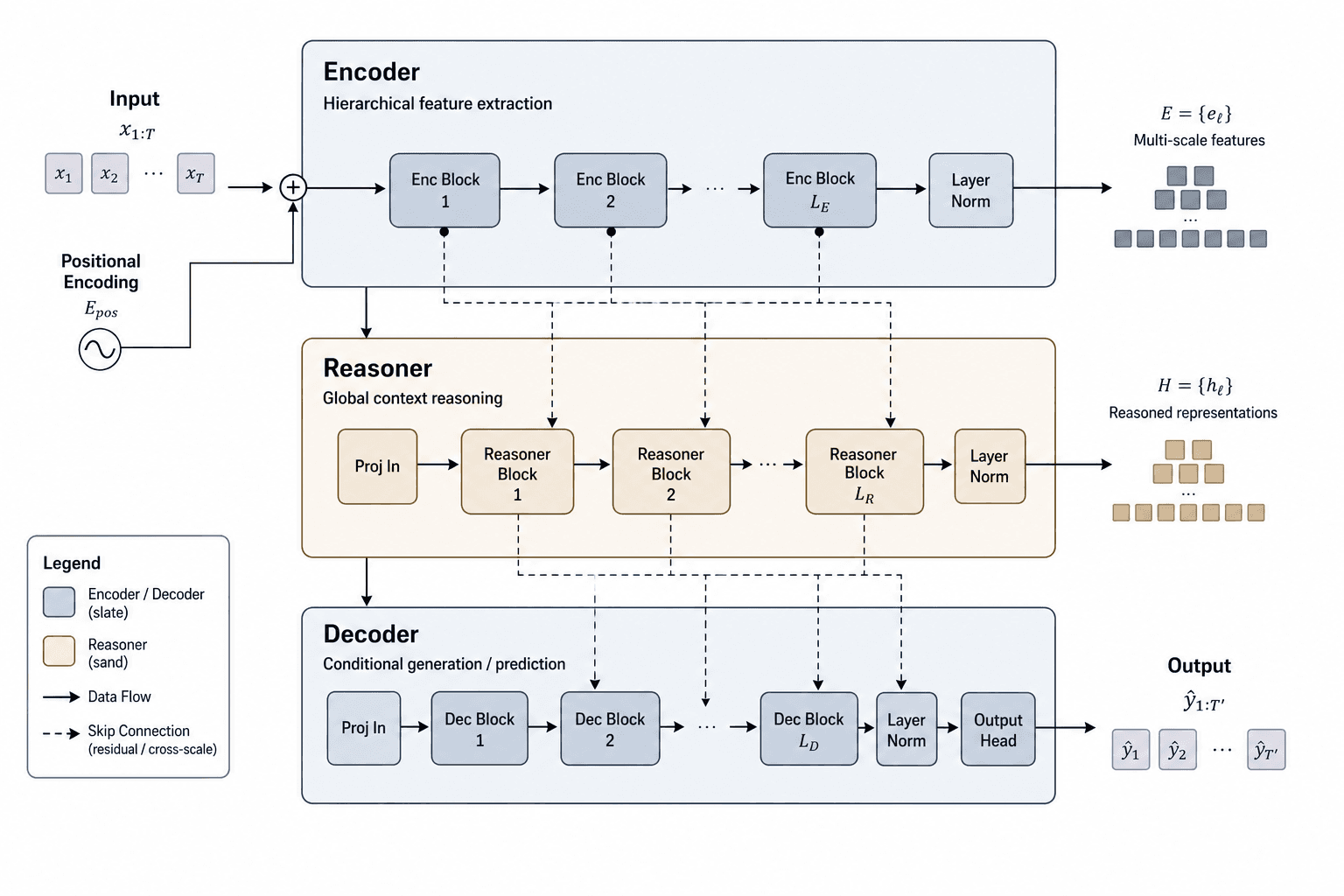
Three tinted stacks sit one above the other for the encoder, reasoner and decoder, with solid lines for the data path and dashed lines for cross-scale skips, explained by a legend at lower left. It suits method figures in sequence modelling work.
Prompt
Create a scientific figure about: Encoder–reasoner–decoder with cross-scale skip paths. Visual style: Clean Vector. Requirements: publication-ready scientific quality, clear labels and directional arrows where appropriate, avoid cartoon or stock-photo look, composition optimized for research papers and academic slides.
What this template is
The figure shows a three-stage neural architecture. An input sequence is summed with a positional encoding and passes through a stack of encoder blocks that extract features at several scales. The reasoner projects those features, runs them through its own blocks for global context reasoning, and emits reasoned representations. A decoder then generates the output sequence conditionally, ending in layer normalization and an output head. Dashed lines carry intermediate features from the encoder and reasoner blocks forward to later blocks. A reader should be able to tell the main data path from the cross-layer shortcuts at a glance.
Elements to label
Input and positional encoding
Token boxes and a sinusoid symbol meeting at a summation node; label the sequence length and the embedding size there.
Encoder stack
A tinted panel of encoder blocks in series followed by layer normalization, with the block count kept as a subscript.
Multi-scale feature output
Stepped tiles at the right showing features at several scales; state the resolution or stride that each level stands for.
Reasoner stack
A sand-coloured panel that projects the features inward, reasons over global context, then normalizes the result.
Decoder and output head
Projection, decoder blocks, layer normalization and an output head in sequence, ending in the predicted tokens.
Cross-scale skip paths
Dashed lines leaving encoder and reasoner blocks for later blocks; say whether they add or concatenate features.
Legend
A boxed key at lower left separating solid data flow from dashed skip connections, and naming what the two panel colours mean.
Projection layers
A projection sits at the head of the reasoner and of the decoder, mapping the previous stage's output into that stage's hidden size.
Where it is used
- Paper mechanism figure
- Defense slides
- Course handout
- Academic poster
What reviewers look for
Where each skip lands
In the sample the dashed lines start under an encoder block and end on the wire between two later blocks, which is ambiguous. Say whether a skip enters a block's input, its output or a residual sum.
Aligning feature dimensions
Cross-scale paths bring features of different resolutions into the same block, so state whether interpolation, pooling or a linear projection aligns them. Without it, nobody can reproduce the model.
Depth and parameter sharing
Block counts appear only as subscripts in the panels. Reviewers will want a table giving the actual depths, hidden sizes and head counts, together with a statement on whether the three stages share any weights.
Does the reasoner earn its place
If reasoner blocks are structurally identical to encoder blocks, a reviewer will ask whether this is simply a deeper encoder. Back the separation with an ablation that removes the reasoner.
How to use it in Yila
- 1Pick a figure
- 2Describe your subject and the steps to stress
- 3Refine it in chat, then download the PNG
Tips
Do
- Rename the blocks after your real modules, such as convolution, state-space or attention blocks, so the figure matches your equations.
- Annotate every dashed line with its fusion rule: addition, concatenation or a gate.
- Keep the encoder and decoder in one colour and the reasoner in another, so the three stages stay distinguishable.
- Mark the output length symbol at the head so it is clearly distinct from the input sequence length.
Avoid
- Writing fixed block counts into the panels unless the text reports exactly those settings.
- Letting the dashed lines cross into a mesh without labels; split them across two sub-figures when there are many of them.
Questions
Can this architecture figure go straight into the method section?
Use it as a draft. It is an AI-generated illustration: the block names are generic and the skip endpoints are imprecise. Rename the modules to match your model and state each connection's start, end and fusion rule in the caption before you submit.
Can I add or remove modules, or change the connections?
The image is not editable element by element and is not a vector graphic. Keep chatting in Yila, for example drop the reasoner, add a second decoder branch, or make the skips gated, and the whole framework is regenerated from your description.
What format is delivered?
An AI-generated PNG image in a 4:3 landscape frame. The three stacked stages suit a full-width paper figure or a wide slide; if the venue requires vector art, redraw it in your diagramming tool following the same hierarchy.
Is it free?
Viewing this page and the sample costs nothing. Generating the figure in Yila, and every revision after that, consumes credits. New accounts receive 2,500 credits, enough for a first version and then stage-by-stage renaming of the blocks and their connections.
Can the loss and training procedure be shown too?
Ask for a loss term at the output head, or for a branch beneath the figure contrasting training with inference. When the model already has many blocks, a separate training diagram keeps the main path from being buried.
Does it suit models that are not sequence based?
The encoder, reasoner and decoder arrangement carries over to image patches, point clouds or graph nodes. Describe the input form in the chat and ask for the multi-scale tiles to be relabelled as the resolution levels your model actually uses, keeping the skip paths in place.