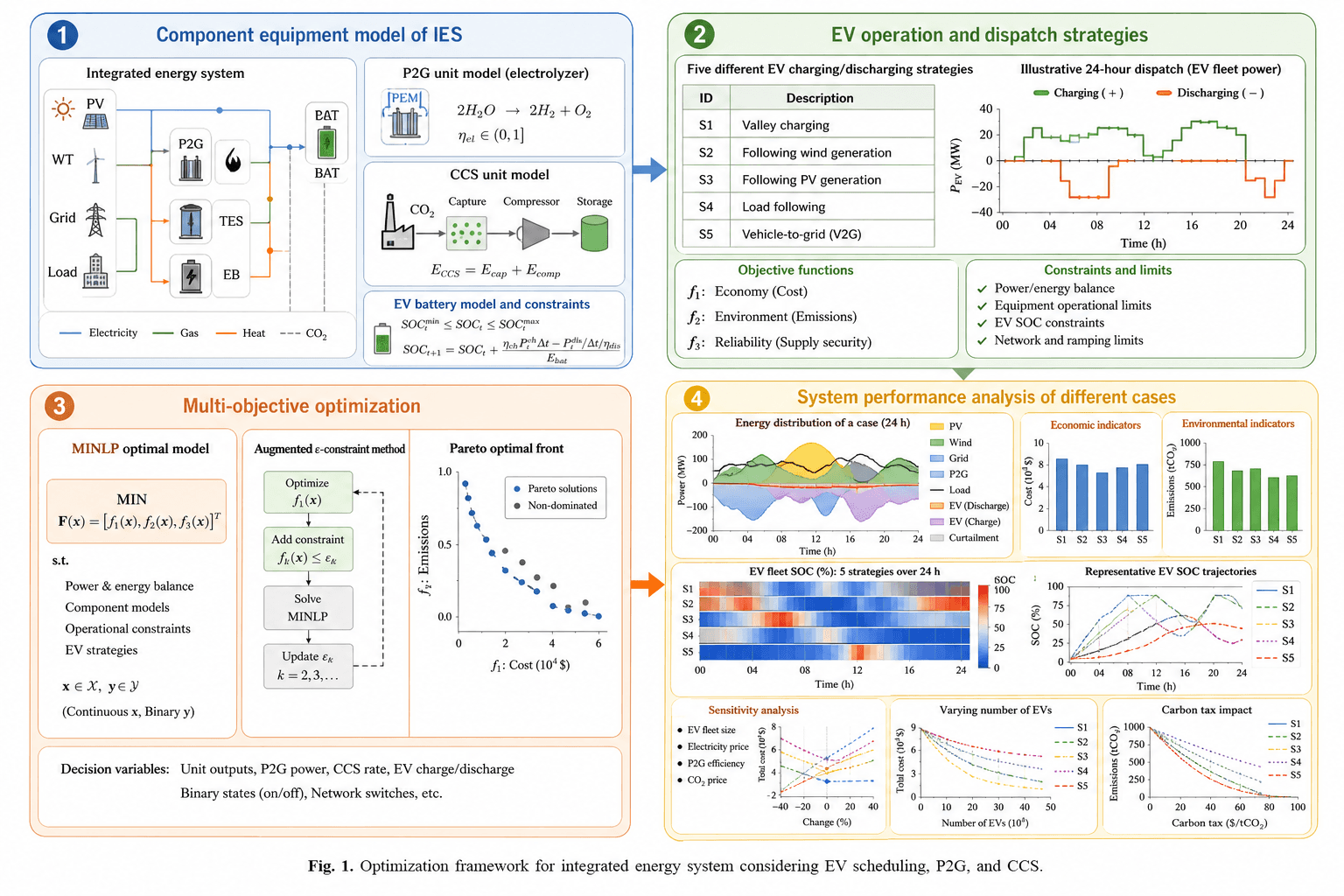
Figure template · Cross-section · 4:3
Earth Interior Layers and Mantle Convection
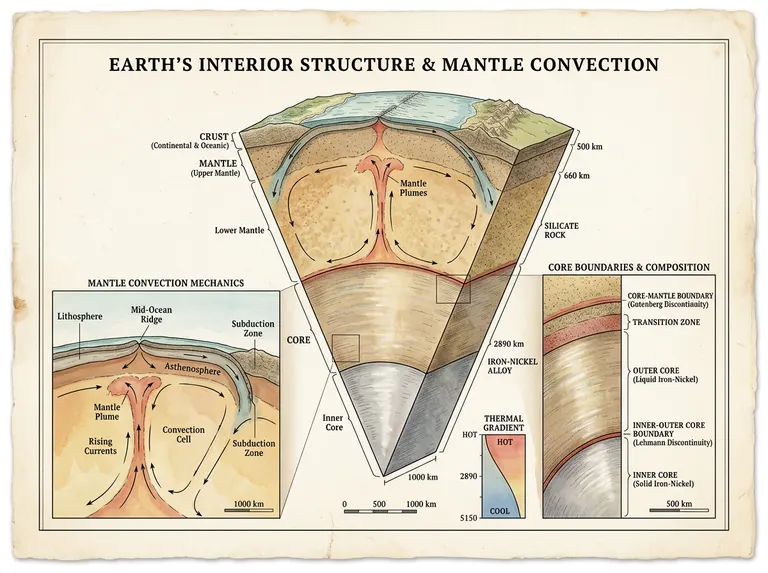
A wedge cut from the surface to the centre, labelled through crust, mantle and core, with circulation arrows and plumes in the mantle, a ridge-and-subduction inset below, and magnified strips for the core boundaries.
Prompt
Create a scientific figure about: Earth interior with mantle convection and core boundaries. Visual style: Clean Vector. Requirements: publication-ready scientific quality, clear labels and directional arrows where appropriate, avoid cartoon or stock-photo look, composition optimized for research papers and academic slides.
What this template is
The wedge opens the planet from outside in. Thin continental and oceanic crust sits over the upper mantle, which passes through a transition zone into the lower mantle; below the core-mantle boundary lies the liquid iron-nickel outer core, and at the centre the solid inner core. Arrows inside the mantle close into circulation cells, with plates separating at a ridge, sinking at a subduction zone, and deep plumes carrying heat back toward the surface. A reader should be able to tell a compositional boundary from one that marks a change of state.
Elements to label
Main wedge
A sector cut from the surface to the centre, keeping ocean and land relief on top to place the section.
Crust and upper mantle
Draw continental and oceanic crust at different thicknesses over the mantle, kept distinct from the lithosphere.
Transition zone and lower mantle
A narrow band between two mantle textures, with its bounding depths printed at the edge of the wedge.
Core-mantle boundary
A magnified strip naming the boundary and showing that composition changes abruptly across it.
Outer and inner core
Colour the two cores apart and note that they share a composition but differ in state.
Convection cells and plumes
Closed circulation arrows in the mantle, with upwelling plumes paired against descending limbs. Keep the arrowheads small.
Convection mechanics inset
A corner panel with ridge, lithosphere, asthenosphere, subduction zone and one complete cell.
Thermal bar and scale
A temperature bar running with depth, and separate scale bars for the wedge and for the inset. Keep both bars visible.
Where it is used
- Paper mechanism figure
- Course handout
- Academic poster
- Defense slides
What reviewers look for
The thermal bar is inverted
In the sample the bar is hot at the top and cool at the bottom while depth increases downward, which says the interior cools with depth. Temperature rises inward, so the bar has to be flipped. Check the labels after flipping.
Boundary names and spelling
The name on the core-mantle boundary is badly garbled in the sample and the inner boundary name needs checking too. A misspelled discontinuity is the first thing a reviewer in this field notices.
Upper mantle depth marks
The transition zone is normally bounded by two widely used depths, and the shallower mark printed here is not one of them. Use the standard values or say which model the figure follows.
Where the slab stops
Whether slabs stall in the transition zone or sink into the lower mantle is still argued. If your text supports whole-mantle flow, do not let every slab in the inset end at shallow depth. Draw one deep limb.
How to use it in Yila
- 1Pick a figure
- 2Describe your subject and the steps to stress
- 3Refine it in chat, then download the PNG
Tips
Do
- Mark the lithosphere-asthenosphere boundary separately rather than reusing the crust-mantle line for both.
- For seismological work, leave room beside the boundaries so travel-time or velocity curves can be added later.
- Decide whether the figure teaches structure or dynamics; for dynamics let the convection inset lead and shrink the wedge.
Avoid
- Do not let the aged paper texture compete with the boundary lines; depth marks must read more clearly than the background.
- Do not force true thickness ratios, which squash the cores out of sight; say the section is not to scale instead.
- Do not give the mantle one flat colour; without a texture change the transition zone disappears between the two shells.
Questions
Can this go straight into a paper?
Use it as a draft schematic. Flip the thermal bar, repair the boundary names, check the depth marks against your reference model, and keep refining it in chat until resolution and type size meet the journal's rules. Say in the caption that depths are schematic.
Can elements in the figure be changed?
Not element by element, but you can keep refining it by chatting in Yila: drop the convection inset, switch to a full circular section, add seismic ray paths, or keep the layering with no flow arrows at all. Ask for one change per message so versions stay comparable.
What format is delivered?
An AI-generated PNG in a landscape vintage-map style. It is not a vector graphic, so if the journal wants clean line art, ask for the aged texture to be removed and then check the depth marks at reduced size. A plain background also prints better.
Is it free?
Browsing this page and viewing the sample cost nothing. Generating your own version in Yila consumes credits, and a new account receives 2,500 credits, enough to retune the depths, colours and labels over several rounds. Group the edits you want before each new round.
Can I make a plate tectonics version?
Yes. Ask for the corner inset to become the main panel with transform faults, a trench and a volcanic arc added, and the wedge reduced to a narrow depth reference beside it for a tectonics handout. Keep one shared depth axis between the panels.
Does it work for another planet?
It does. Name the body and how you divide its interior; the wedge, boundary insets and temperature bar all carry over, while layer names, depth marks and colours are rewritten for that planet. Leave out any shell your data cannot constrain.