
Figure template · Cross-section · 4:3
Zinc-Ion Cell Cross-Section with a Redox-Shuttle Cycle
A cross-section of a discharging zinc-ion cell, with zinc ions crossing the separator into a framework cathode and electrons lighting a bulb, set beside a cycle in which a shuttle molecule switches between its oxidized and reduced forms.
Prompt
Create a scientific figure about: Zinc-ion cell cross-section with a redox-shuttle cycle. Visual style: Clean Vector. Requirements: publication-ready scientific quality, clear labels and directional arrows where appropriate, avoid cartoon or stock-photo look, composition optimized for research papers and academic slides.
What this template is
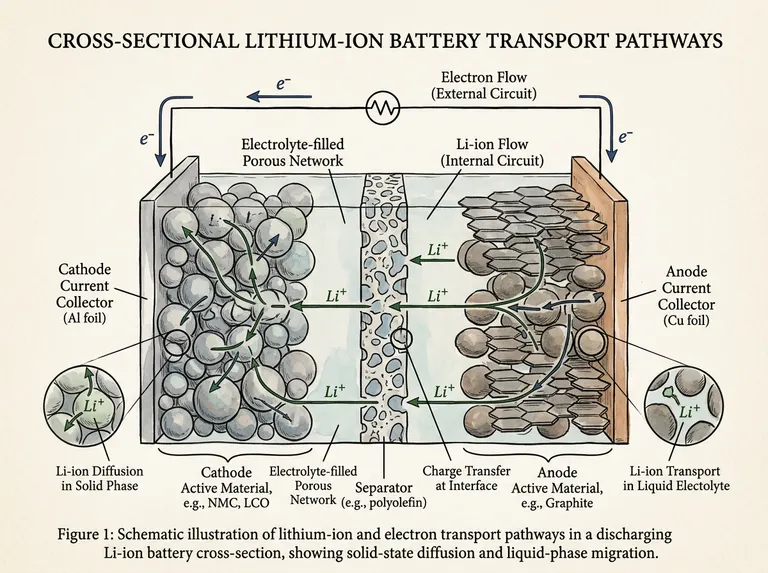
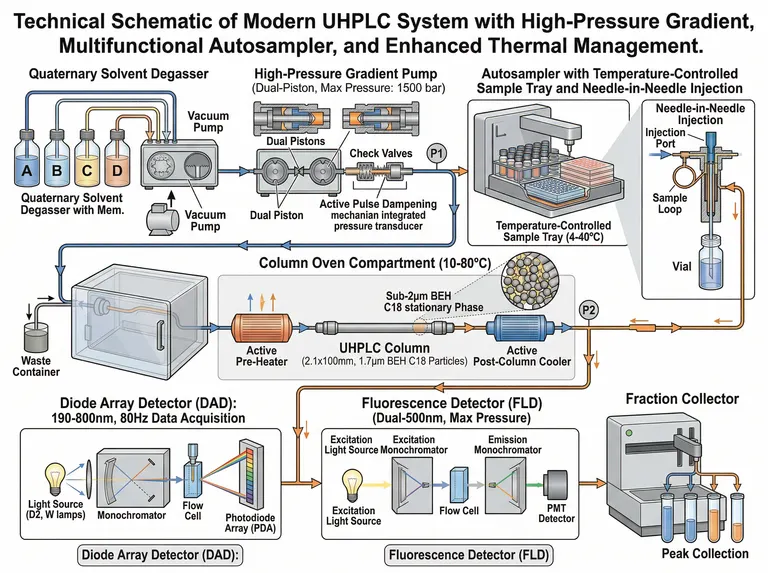
On the left, grey zinc particles pack against a copper-coloured current collector as the anode; on the right, a framework of yellow octahedra and red oxygen atoms on a grey collector forms the cathode, with teal zinc ions lodged inside. A fibrous separator stands between them, crossed by dashed arrows labelled ion transport, and a wire across the top carries electrons through a light bulb. On the right, a carbonyl-bearing molecule labelled oxidized sits above a hydroxyl-bearing one labelled reduced, with arcs marked oxidation at cathode and reduction at anode. Readers should see two parallel paths: zinc ions moving between electrodes and a mediator shuttling charge.
Elements to label
Zinc anode
Packed grey spheres on the left; say whether it is zinc powder or foil and whether it carries a protective coating.
Separator and ion transport
The fibrous sheet with dashed arrows on both sides; add the electrolyte salt and solvent you use.
Framework cathode
Yellow octahedra with red oxygen atoms form tunnels; name the actual manganese or vanadium oxide you use.
Zinc ions
Teal spheres moving between the electrodes; several are labelled only Zn, so standardise on Zn²⁺ throughout.
External circuit
A bulb and electron arrows across the top of the cell; note in the caption that the drawing depicts discharge.
Oxidized shuttle
The ring molecule with two carbonyls at upper right; replace it with the real structure of your mediator.
Reduced shuttle
The hydroxyl-bearing molecule below it; it must be the same compound after gaining electrons and protons.
Current collectors
Copper-coloured on the anode side and grey on the cathode side; name the collector materials your cell actually uses.
Where it is used
- Paper mechanism figure
- Graphical abstract
- Defense slides
- Course handout
What reviewers look for
Shuttle structures
The oxidized and reduced molecules have different skeletons, and the oxidized form carries an unusual four-membered ring. Reviewers will check that the pair differs only by electrons and protons and comes from your actual compound.
Cycle direction
Both arcs carry arrowheads at each end, so the direction of oxidation and reduction is ambiguous. Use a one-way loop and say at which electrode the shuttle loses electrons and at which it gains them.
Purpose of the shuttle
Redox shuttles serve overcharge protection or soluble-mediator storage, which work differently. Reviewers will ask which role applies here and where the shuttle molecules sit within the cell drawing. Draw them in the electrolyte.
Ion labels and legend
Ions in the cell are labelled Zn while the legend shows a dashed Zn²⁺ circle that matches none of the solid teal spheres. Use one symbol and one legend style for the same species.
How to use it in Yila
- 1Pick a figure
- 2Describe your subject and the steps to stress
- 3Refine it in chat, then download the PNG
Tips
Do
- Give the exact name or structure of your shuttle molecule so the model does not invent a skeleton for it.
- Ask for a few shuttle molecules in the electrolyte, linked by arrows to the cycle on the right.
- State whether the cell is charging or discharging so the electron and ion arrows agree with it.
Avoid
- Keeping double-headed arcs in the cycle, which leave the redox direction unclear to readers.
- Labelling ions Zn in the cell but Zn²⁺ in the legend; one species should have one symbol.
- Trusting any bond or ring in the sample molecules; draw final structures in chemistry software.
Questions
Can this zinc-ion shuttle figure go directly into my paper?
Only as a starting layout. It is AI-generated: the two shuttle structures on the right do not describe one compound, and the cathode lattice is schematic. Replace them with your real molecule and electrode material, and have a co-author who knows electrochemistry check every part before submission.
Can I change the molecules or the electrode materials?
Atoms and molecules cannot be selected and edited, and the image is not a vector file. Give your mediator, cathode and operating state in a Yila chat and the figure is regenerated. For exact structures, draw them in chemistry software and combine the two afterwards. Keep the cell layout unchanged meanwhile.
What is the output format?
An AI-generated PNG in landscape, with the cell cross-section on the left and the shuttle cycle on the right. For vector chemical structures, redraw the molecules in chemistry drawing software and place them over a cleaned version of the cell. Keep atom colours consistent.
Does generating it cost anything?
Browsing this page and the sample costs nothing. Generating and editing in Yila consumes credits, and new accounts receive 2,500 credits on sign-up for trying several layouts before refining the chemistry details. Viewing samples never uses credits.
My system is lithium–sulfur or a flow battery. Will this work?
Yes. Describe the electrodes, electrolyte and shuttling species, such as polysulfides or a dissolved mediator, and Yila swaps the materials and adjusts the cycle. Shuttle direction differs between chemistries, so spell it out for yours. The bulb circuit can stay as drawn.
Can dendrites or side reactions be shown too?
Yes. Ask for dendrite growth or hydrogen bubbles on the anode surface, drawn in a distinct colour from normal deposition. If your argument is that the mediator suppresses these side reactions, have arrows link the cycle to the affected region. Keep the cycle on the right.