Figure template · Cross-section · 4:3
Lithium-Ion Battery Cross-Section Transport Figure
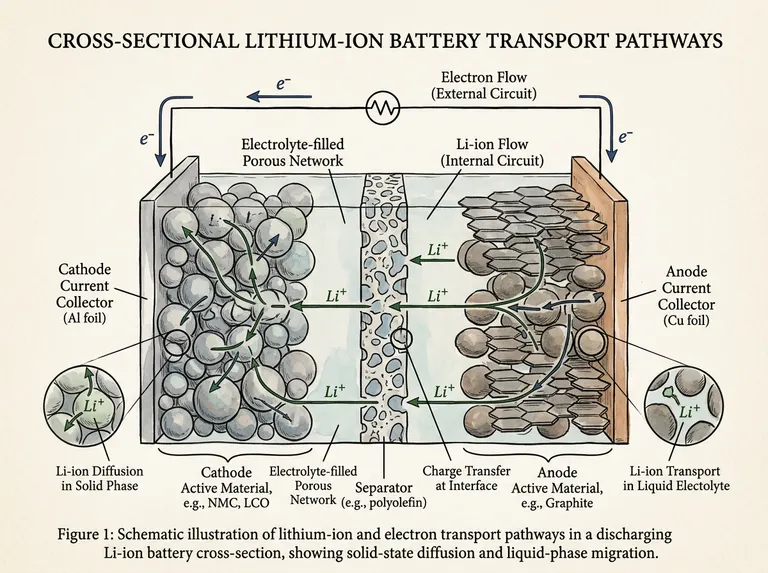
A hand-drawn cross-section with cathode particles on one side, a porous separator in the middle and layered graphite on the other, where ions cross the separator while electrons detour through the external circuit.
Prompt
Create a scientific figure about: Lithium-ion battery cross-sectional transport pathways. Visual style: Clean Vector. Requirements: publication-ready scientific quality, clear labels and directional arrows where appropriate, avoid cartoon or stock-photo look, composition optimized for research papers and academic slides.
What this template is
The figure puts both transport routes of a discharging cell on one section. Lithium leaves the graphite, migrates through the electrolyte filling the pore network, crosses the separator into the positive side, diffuses inside an active particle and transfers charge at its surface. Electrons cannot cross the separator, so they travel through the current collectors and the external circuit instead. A reader should be able to tell which stretch is liquid-phase migration and which is solid-state diffusion, and where the two meet.
Elements to label
Current collectors
A metal foil on each side, named by material and pressed against its coating with no gap drawn between them.
Cathode particle layer
Packed spherical particles of the positive coating, with visible voids between them for the electrolyte to fill.
Graphite layer
Platelet-shaped particles that read differently from the spheres and show the layered host structure.
Separator
A porous strip through the middle, named by material and drawn with through-pores rather than as a solid film. Keep it narrower than the coatings.
Ion arrows
Arrows running from the negative side across the separator to the positive side, carrying the ion symbol. Space them evenly.
External circuit
A wire across the top with a load symbol, the electron arrows matching the ion direction for this operating mode. Label the load clearly.
Two magnified circles
One circle for diffusion inside a particle, one for migration in the liquid, each with a line of caption. Anchor each circle to its origin.
Interfacial charge transfer
A leader at the particle-electrolyte boundary marking where charge transfer happens and in which direction.
Where it is used
- Paper mechanism figure
- Course handout
- Defense slides
- Grant proposal
What reviewers look for
Electron arrows must agree
On discharge electrons leave the negative collector and return through the circuit to the positive one. The sample points both end arrows inward, so the negative side is reversed and the current loop does not close. Check both ends before submission.
State charge or discharge
Both ion and electron directions reverse between charging and discharging, so naming the cell is not enough; put the operating mode in the title or next to the arrows. Readers check that first.
Do not omit the interphase
The solid electrolyte interphase on graphite sets much of the interfacial resistance. If your text discusses impedance or capacity fade, draw and label that film on the negative particles. A thin outline is enough.
Porosity and tortuosity
Liquid-phase transport depends on porosity and a winding path, so draw the ion route inside the electrolyte circle as a detour rather than a straight line and mention effective diffusivity. State it in the caption.
How to use it in Yila
- 1Pick a figure
- 2Describe your subject and the steps to stress
- 3Refine it in chat, then download the PNG
Tips
Do
- Name your own electrode materials in the prompt so particle shapes and captions match the chemistry you study.
- If one step is rate limiting, ask for that arrow to be drawn heavier while the rest of the path stays thin.
- Fix which electrode sits on which side and keep that orientation across every figure in the paper.
Avoid
- Do not keep the figure number drawn into the image; journals set their own numbering and it has to be painted out.
- Do not let the hand-drawn texture overwhelm the structure; particle edges and separator pores must read more clearly than the brushwork.
- Do not draw the separator as a solid band; without visible pores the ion arrows appear to cross a barrier.
Questions
Can this go straight into a paper?
Treat it as a draft mechanism figure. Correct the electron direction, state whether the cell is charging or discharging, check the material captions and spelling, then keep refining it in chat for your journal's figure rules. Keep the caption outside the artwork.
Can elements in the figure be changed?
Not element by element, but you can keep refining it by chatting in Yila: switch to a solid electrolyte, add the interphase film, replace graphite with a silicon-based anode, or drop the magnified circles and keep the section alone. Ask for one change at a time so the section stays comparable.
What format is delivered?
An AI-generated PNG in a landscape hand-drawn style. It is not a vector graphic, so if the journal wants line art, ask in chat for a clean line version and check the captions at reduced size. A taller frame suits a stacked layout.
Is it free?
Browsing this page and viewing the sample cost nothing. Generating your own version in Yila consumes credits, and a new account receives 2,500 credits, enough to rebuild the section around your chemistry over several rounds of arrows and labels. Batch your edits so fewer rounds are needed.
Can it show charging instead?
Yes. Ask for both ion and electron directions reversed, the load replaced by a power source symbol, and the insertion and extraction captions swapped between the sides; the section itself stays as it is. Update the title wording as well.
Does it work for a sodium-ion cell?
It does. Change the carrier to sodium ions and the negative electrode to a hard carbon, keeping the particle layers, separator and pore network as drawn, then rewrite the material captions for your own system. Mention the ion radius difference in the caption if it matters.