
Figure template · Mechanism & Pathway · 4:3
Stretch–Relax Hydrogel Network and Crosslink Mechanics
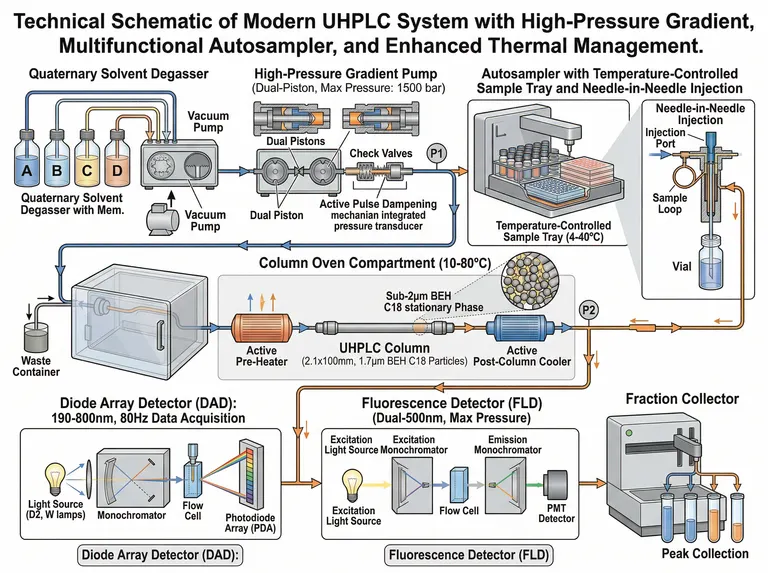
A two-row comparison of a hydrogel at rest and under tension: zoomed boxes show coiled chains between crosslinks straightening along the pull, and a lower row repeats the change at the scale of a whole gel strip for lectures or papers.
Prompt
Create a scientific figure about: Stretch–relax hydrogel network with crosslink mechanics. Visual style: Clean Vector. Requirements: publication-ready scientific quality, clear labels and directional arrows where appropriate, avoid cartoon or stock-photo look, composition optimized for research papers and academic slides.
What this template is
On the left, a translucent relaxed block holds randomly coiled chains dotted with teal and coral nodes, and a dashed zoom box labels one coral node as a crosslink. Paired Stretch and Relax arrows lead to a stretched bar on the right, whose zoom box shows chain segments running almost parallel. A bottom row repeats the cycle with a plain gel strip and a dashed outline. The reader should come away understanding that crosslinks fix the network topology, stretching lowers the conformational entropy of the chains, and removing the load lets them recoil so the gel recovers its length.
Elements to label
Relaxed block
The translucent cube at upper left; add water content or crosslink density beside its Relaxed state title.
Coiled polymer chains
Teal random coils fill the network; name the polymer, for example polyacrylamide, in a label or caption.
Coral crosslinks
The only node with a leader line, labelled Crosslink; specify covalent or reversible physical bonding.
Teal nodes
Left unexplained in the sample; add a legend entry saying whether they are a second crosslink, entanglements or chain ends.
Stretch and Relax arrows
A green rightward and red leftward pair; you can write the strain or loading rate above them.
Relaxed-state zoom
The dashed box beside the cube shows coiled chains and both node colours; enlarge it if crosslink spacing is your point.
Stretched-state zoom
The dashed box at right shows aligned segments; note that the alignment follows the loading direction.
Macroscopic gel strip
The bottom row shows the whole sample lengthening; label the dashed outline as original or maximum length.
Where it is used
- Paper mechanism figure
- Defense slides
- Course handout
- Academic poster
What reviewers look for
Two node types
Only one of the two node colours is labelled. Reviewers will want to know whether they are two crosslinks of a double network, sacrificial and permanent bonds, or crosslinks and entanglements, since each predicts different mechanics.
Energy dissipation
If the paper claims toughness or hysteresis, the stretched state should show reversible bonds breaking and re-forming on relaxation. Here both states keep exactly the same crosslinks, so dissipation is invisible.
Lateral contraction
The stretched bar thins sharply. A reviewer may check whether that contraction matches the material's Poisson ratio and whether a swollen gel would really conserve volume in the way it is drawn.
The dashed outline
In the bottom row the dashed box extends past the stretched strip, so readers cannot tell whether it marks original or maximum length. Clarify it in the caption or have Yila redraw the row.
How to use it in Yila
- 1Pick a figure
- 2Describe your subject and the steps to stress
- 3Refine it in chat, then download the PNG
Tips
Do
- State your crosslink chemistry, covalent, ionic or hydrogen-bonded, so each node colour gets one clear meaning.
- Ask for some reversible crosslinks to appear broken in the stretched state to illustrate hysteresis.
- Request a small schematic stress–strain curve beside the bottom strip to link network and bulk behaviour.
Avoid
- Labelling only one node type and leaving readers to guess what the other colour stands for.
- Letting the stretch ratio differ wildly between the molecular row and the bulk row, which breaks the comparison.
- Drawing so many chains in the zoom boxes that individual crosslinks can no longer be picked out at column width.
Questions
Can this crosslink mechanics figure go straight into my paper?
It works as a concept figure for network deformation, but it is AI-generated: chain count, node placement and stretch ratio do not reflect your measurements. Add a legend for both node types, align the terms with your text, and have co-authors check it against your mechanical data before submission.
Can I recolour nodes or reshape chains myself?
Single nodes or chain segments cannot be selected and edited, and the image is not a vector file. Ask for the change in a Yila chat, for example turning the teal nodes into entanglements and adding a legend, and the figure is regenerated with the new scheme.
Which format is delivered?
You receive an AI-generated PNG with a landscape layout, and the two rows lend themselves to step-by-step slides. For a vector version, use the PNG as a layout draft and redraw the blocks and networks in illustration software. Keep the zoom boxes at least as large as in the sample so the nodes stay legible in print.
Is there a charge?
Viewing the page and the sample costs nothing. Generating your own version in Yila and each later edit consume credits, and every new account receives 2,500 credits to start with, enough for several rounds of revisions.
I work on double-network hydrogels. Can it show two networks?
Yes. Describe the composition and crosslinking of the first and second networks and ask for two colours. In the stretched state the brittle first network can be shown partly fractured, which illustrates sacrificial bonding better than the single network in the sample.
Can I keep only the molecular row and drop the gel strip?
Yes. Ask Yila to draw just the two network states and their zoom boxes; the freed space lets the chains and crosslinks appear larger. You can also ask for several intermediate states to depict cyclic loading. Fewer elements also make the figure easier to read in a single journal column.