
Figure template · System & Network · 4:3
Coupled Human–Natural Systems Carbon Exchange Figure
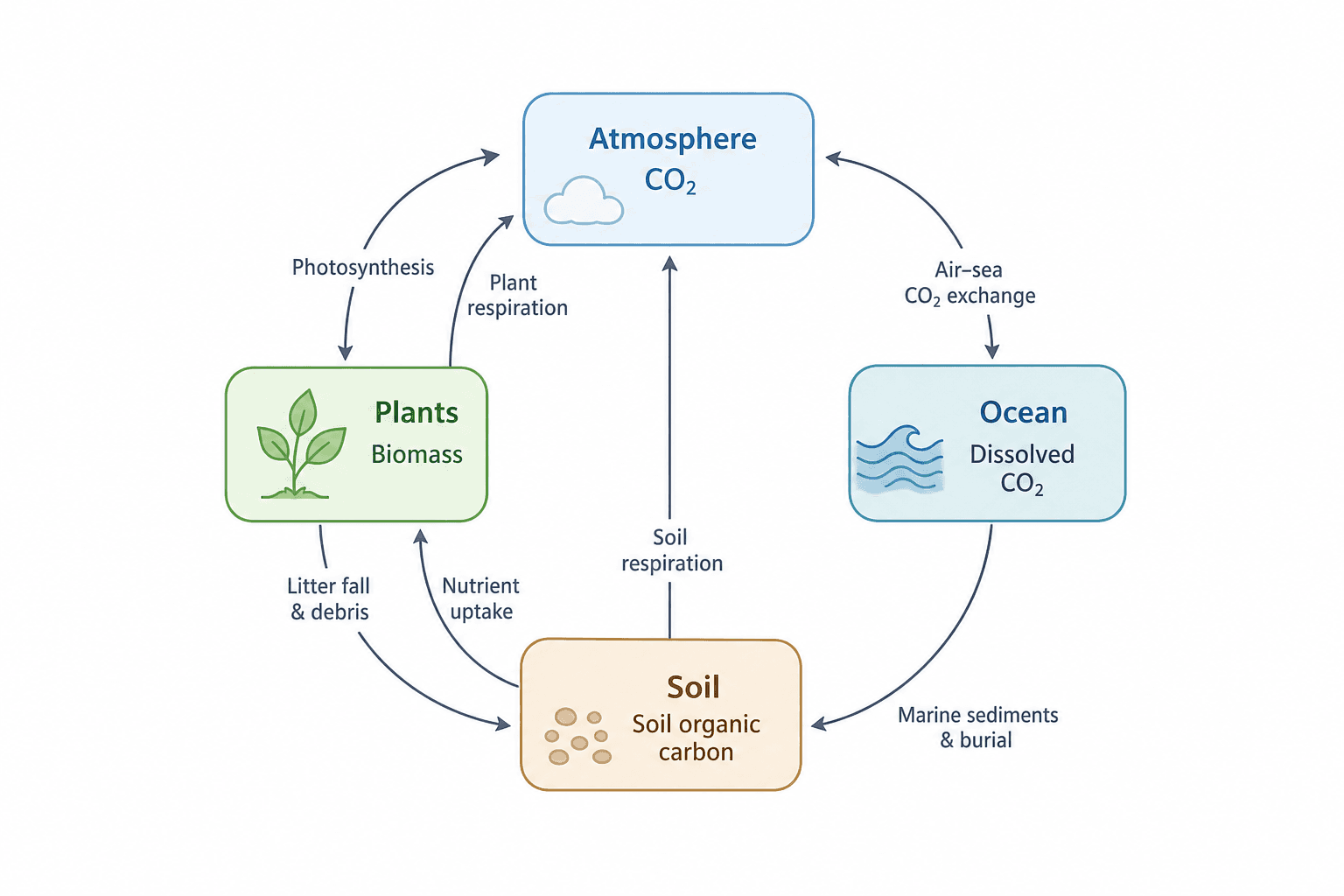
Four rounded boxes, one on each side of the frame, joined by labelled curved arrows into a closed carbon loop. Use it as the natural half of a coupled human–natural systems figure in landscape ecology, carbon accounting or land-system papers.
Prompt
Create a scientific figure about: Coupled human–natural systems across landscape mosaics. Visual style: Clean Vector. Requirements: publication-ready scientific quality, clear labels and directional arrows where appropriate, avoid cartoon or stock-photo look, composition optimized for research papers and academic slides.
What this template is
The sample traces carbon between the natural compartments of a landscape. Plants draw CO₂ from the atmosphere by photosynthesis and return part of it through respiration; litter fall moves carbon into soil organic matter, and soil respiration releases some of it again; the ocean exchanges CO₂ with the air and locks carbon away in sediments. A reader should come away knowing which way every flux runs. What the sample does not yet show is the human side: settlements, cropland, emissions and policy all have to be described before the figure lives up to its title.
Elements to label
Atmosphere CO₂ pool
Blue box at the top with a cloud icon; every flux meets here, so keep the subscript in the label.
Plant biomass
Green box on the left with a seedling icon; rename it after the dominant vegetation of your study area, such as boreal forest or grassland.
Soil organic carbon
Tan box at the bottom with soil aggregates; specify peat or wetland soils if that is what you measured.
Ocean dissolved CO₂
Teal box on the right with waves; for an inland catchment, swap it for a lake or river compartment and rewrite its two fluxes.
Photosynthesis and plant respiration
Two opposing curved arrows between atmosphere and plants, labels set outside the curves.
Litter fall and nutrient uptake
A down-and-back pair between plants and soil: debris goes down, nutrients come back up.
Soil respiration
The single straight vertical arrow, running from soil to atmosphere and labelled at its midpoint; it contrasts with the curved fluxes around it.
Air–sea exchange and sediment burial
Two arcs on the right, one between atmosphere and ocean and one carrying ocean carbon toward burial.
Where it is used
- Paper mechanism figure
- Graphical abstract
- Course handout
- Grant proposal
What reviewers look for
Where are the humans?
A coupled human–natural systems figure needs land-use change, fossil emissions or management actions drawn in, with feedback arrows to the pools they alter and back again. The sample has none of these, and a reviewer in land-system science will notice at once.
One-way photosynthesis
Carbon fixation runs from atmosphere to plants only. In the sample the photosynthesis curve appears to carry arrowheads at both ends; keep only the head pointing at the plant box.
Marine burial is not soil carbon
The sediment-burial arc ends on the soil organic carbon box, merging two reservoirs that have nothing to do with each other. Give marine sediments their own compartment or redirect the arrow before using the figure anywhere formal.
Mixed currencies on the arrows
Nutrient uptake moves nitrogen and phosphorus, not carbon, yet it uses the same arrow style as every carbon flux around it. Distinguish it with a dashed line or a second colour, and say so in the legend.
How to use it in Yila
- 1Pick a figure
- 2Describe your subject and the steps to stress
- 3Refine it in chat, then download the PNG
Tips
Do
- Name your human subsystems, such as farms, towns and land policy, and say which carbon pools each one pushes on.
- If you have measured fluxes, ask for arrow widths that scale with them so the dominant pathway stands out.
- Replace the ocean box with the water body your study area actually drains into.
Avoid
- Submitting the sample as a coupled-systems figure; a carbon cycle without people contradicts its own title.
- Stacking text boxes on the central soil-respiration arrow, the one straight line that anchors the layout.
- Drawing the human compartments as decoration at the edges; each needs at least one arrow into and one out of the carbon loop.
Questions
Can it go straight into a paper as my coupled-systems figure?
Treat it as a draft. It is AI-generated, it shows only natural carbon pools, and two arrows need correcting: photosynthesis direction and where sediment burial ends. Add the human compartments and check each flux against your data before it becomes a formal figure.
Can elements in the figure be changed, for example adding cities or cropland?
Yes, by describing them in chat. The PNG is not editable element by element, so Yila regenerates the whole figure with your social compartments, the flows between them and the carbon pools they influence.
What format is delivered?
An AI-generated PNG in landscape orientation, not a vector graphic. If a journal requires vector artwork, keep the PNG as a layout reference and redraw the four-box loop in your drawing software, adding the human compartments there.
Is it free?
Opening this page and viewing the sample costs nothing. Generating your own version in Yila, and each revision, consumes credits. A new account starts with 2,500 credits, enough to try several versions of a coupled-systems figure for your study region.
Can it show a mosaic of several landscape patches?
Describe the patch types, for instance woodland, arable land and built-up area, plus the flows of material or people between them. Yila can then replace the single loop with side-by-side patches joined by arrows, which suits a true landscape mosaic.
Can it illustrate the effect of a carbon-sink policy or management practice?
Yes. Say which pool the intervention acts on and whether it raises uptake or cuts emissions. Yila can mark the intervention beside the affected arrow and use colour to contrast fluxes before and after it, a common need when a grant proposal has to explain expected outcomes.