Figure template · Lab Apparatus · 4:3
Droplet Digital PCR Workflow Diagram
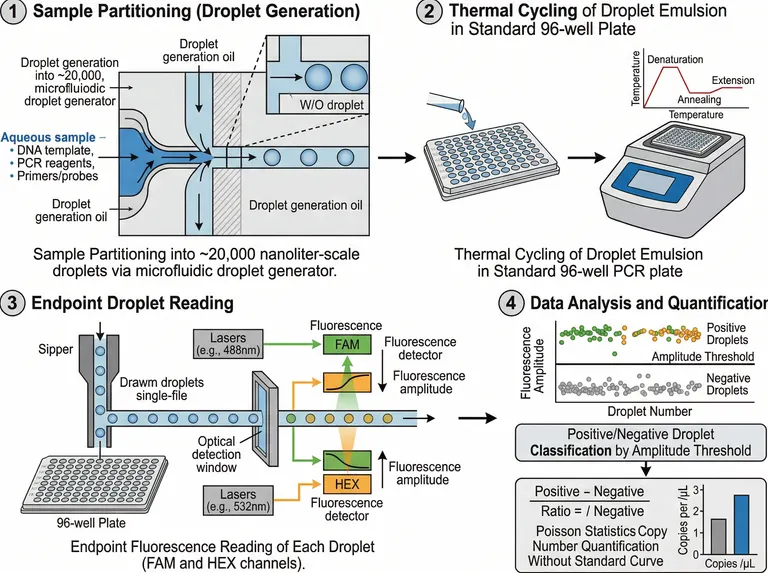
A four-step numbered diagram that partitions the reaction into water-in-oil droplets, cycles them in a plate, reads them single file through two fluorescence channels, and ends on threshold classification and a copy concentration bar.
Prompt
Create a scientific figure about: Droplet digital PCR system with microfluidic droplet generation, thermal cycling, and fluorescence readout. Visual style: Clean Vector. Requirements: publication-ready scientific quality, clear labels and directional arrows where appropriate, avoid cartoon or stock-photo look, composition optimized for research papers and academic slides.
What this template is
The four panels read in order. An aqueous mix of template, primers, probes and enzyme meets oil at a microfluidic cross and is sheared into uniform water-in-oil droplets. The emulsion is transferred to a plate and cycled through denaturation, annealing and extension. Droplets are then drawn single file past an optical window where two excitation lines read two fluorescence channels. Finally an amplitude threshold splits the population into positive and negative droplets, and Poisson statistics convert that split into a copy concentration without any standard curve.
Elements to label
Aqueous inlet
List template, primers and probes, and reagent mix at the channel entrance, with arrows converging on the cross.
Shearing cross junction
Oil enters from above and below; draw the thread pinching off and the droplet that has just formed.
Water-in-oil inset
A boxed close-up of one droplet in section, stating which phase is inside and which surrounds it.
Thermal cycling panel
The emulsion moves into a plate and onto the cycler, with the profile beside it marking all three cycling steps.
Single-file reading path
A sipper lines droplets up one by one through the optical window, with the excitation paths drawn behind it.
Two-channel detection
Give each channel its own excitation line and detector, and show which way the amplitude axis runs.
Threshold scatter
Droplet index on the horizontal axis, amplitude on the vertical, positives above the threshold line and negatives below.
Copy concentration bar
Close with the Poisson-derived concentration and a note that no standard curve is needed. Keep the unit on the axis.
Where it is used
- Paper mechanism figure
- Defense slides
- Course handout
- Grant proposal
What reviewers look for
Axis of the cycling profile
The sample labels the horizontal axis of the thermal profile as temperature as well, so it plots temperature against temperature. Change it to time or cycle number before the figure goes anywhere. The three cycling steps then line up left to right.
The Poisson expression
The ratio formula in the final panel is printed as broken fragments. Either write the relation between the negative fraction and the mean copies per droplet properly, or keep a sentence of text and no formula at all.
Say how the threshold was set
Droplets with intermediate amplitude sit between the two clusters, and reviewers ask whether the line came from no-template controls or a clustering method. A sentence beside the scatter convinces more than the line itself.
Droplet count and volume
Concentration follows from accepted droplets and droplet volume, so if the panel prints a droplet count, also say which droplets were excluded, or the arithmetic will not reconcile.
How to use it in Yila
- 1Pick a figure
- 2Describe your subject and the steps to stress
- 3Refine it in chat, then download the PNG
Tips
Do
- Name your targets and the probe on each channel in the prompt so the channel labels carry your assay, not placeholders.
- For copy number variation or rare mutation work, ask for a band of intermediate droplets so the scatter looks like real data.
- Decide how you set the threshold before generating; that one line shapes how readers judge the whole scatter panel.
Avoid
- Do not keep the misspelled captions from the sample; a workflow figure is read label by label.
- Do not crowd all four panels with sentences; the numbering already carries the order, so one line each is enough.
- Do not leave the broken ratio expression in the last panel; a half-formula reads as a mistake in the statistics.
Questions
Can this go straight into a paper?
Treat it as a draft methods figure. Fix the cycling axis, complete or remove the broken formula, and check the channel labels against your assay, then keep refining it in chat until the resolution and type size meet the journal's rules.
Can elements in the figure be changed?
Not element by element, but you can keep refining it by chatting in Yila: move to a single channel, replace the scatter with a two-channel plot, drop the cycling panel, or add sample preparation upstream, then generate a new version. One change per message keeps the panels comparable.
What format is delivered?
An AI-generated PNG laid out as four landscape panels for a slide or handout. It is not a vector graphic, so check the axis text and channel labels after reduction, and ask for a two-row arrangement if they crowd.
Is it free?
Reading this page and looking at the sample cost nothing. Generating your own version in Yila consumes credits, and a new account receives 2,500 credits, enough to rebuild all four panels around your own assay several times. Batch the edits you want so fewer regenerations are needed.
I run chip-based digital PCR. Does it fit?
Yes. Replace the shearing cross with a partitioning array on a chip and call the compartments reaction wells; the cycling, fluorescence reading and Poisson panels carry over unchanged. Say in the prompt that compartments are fixed in place rather than flowing, so the reading panel shows an imaged array instead of a sipper.
Can I keep only the first two panels for teaching?
Ask for droplet generation and thermal cycling alone, enlarged to fill the frame. That version suits a lecture on partitioning, and a line about droplet volume can be added beside it. Ask for larger captions in that teaching version.