
How to Use Yila to Write a High-Quality, Traceable Literature Review with Citations
A complete guide to using Yila for a high-quality, traceable literature review, from scoping and real-paper retrieval to core-reference screening, evidence mapping, outlining, synthesis, and citation validation.
A genuinely challenging literature review is not about summarizing dozens of papers one by one. It is about answering three more important questions: What consensus has emerged in the field? Which conclusions remain disputed? Where are the most valuable gaps for future research?
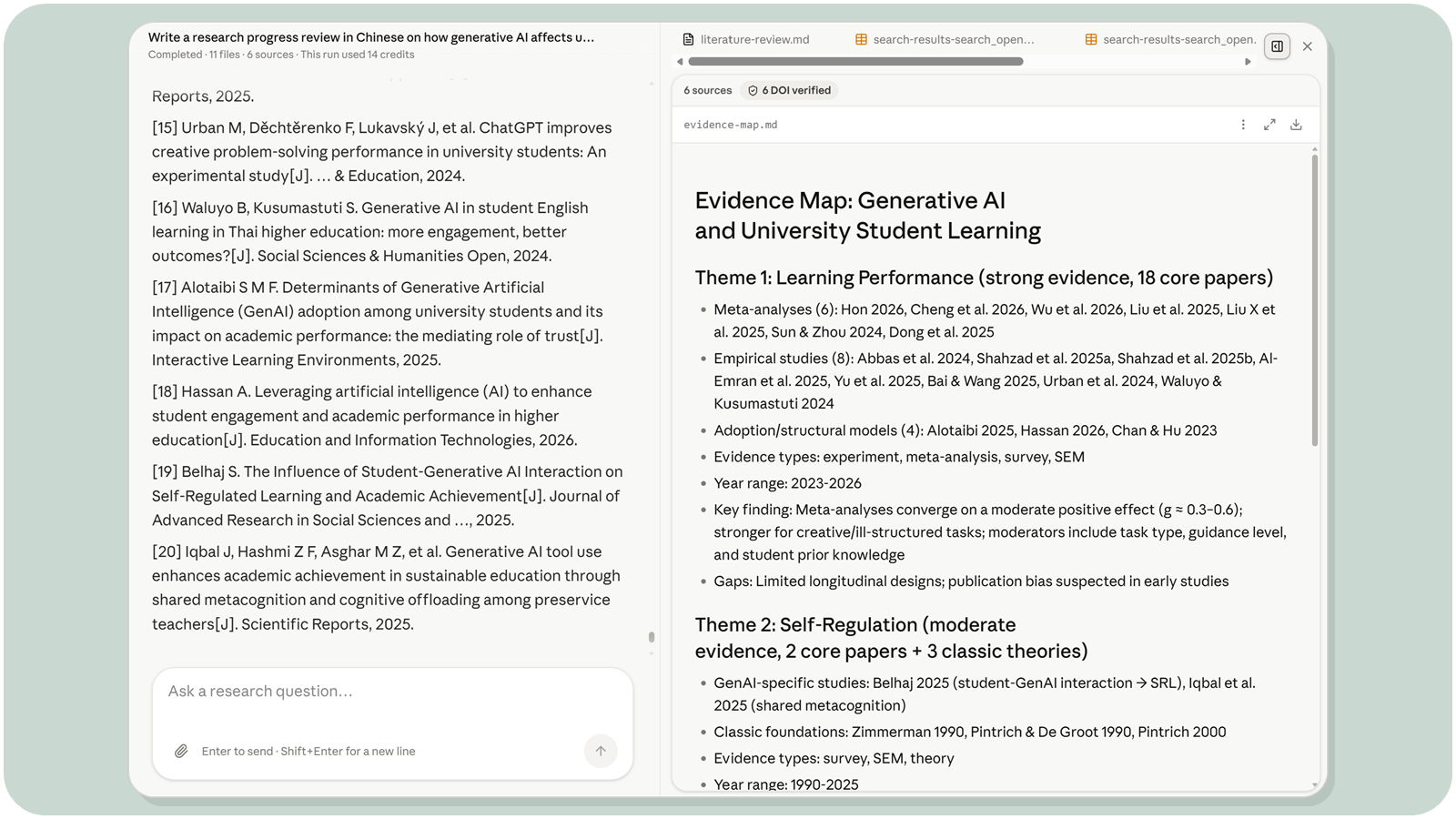
Yila's literature review feature is designed around these three questions. Instead of generating a seemingly complete article directly from model memory, it first retrieves real papers, builds a candidate paper pool, selects core references, maps the strength of evidence and relationships among themes, and then develops the article structure and writes a cited review.
This guide walks through the complete workflow, from defining the research scope to downloading the final output, and explains how to write more effective task instructions.
Estimated time: A standard review usually takes about 9-15 minutes. Actual time depends on the scope, number of candidate papers, desired length, and whether you choose to review the outline first.
Quick Start in 3 Minutes
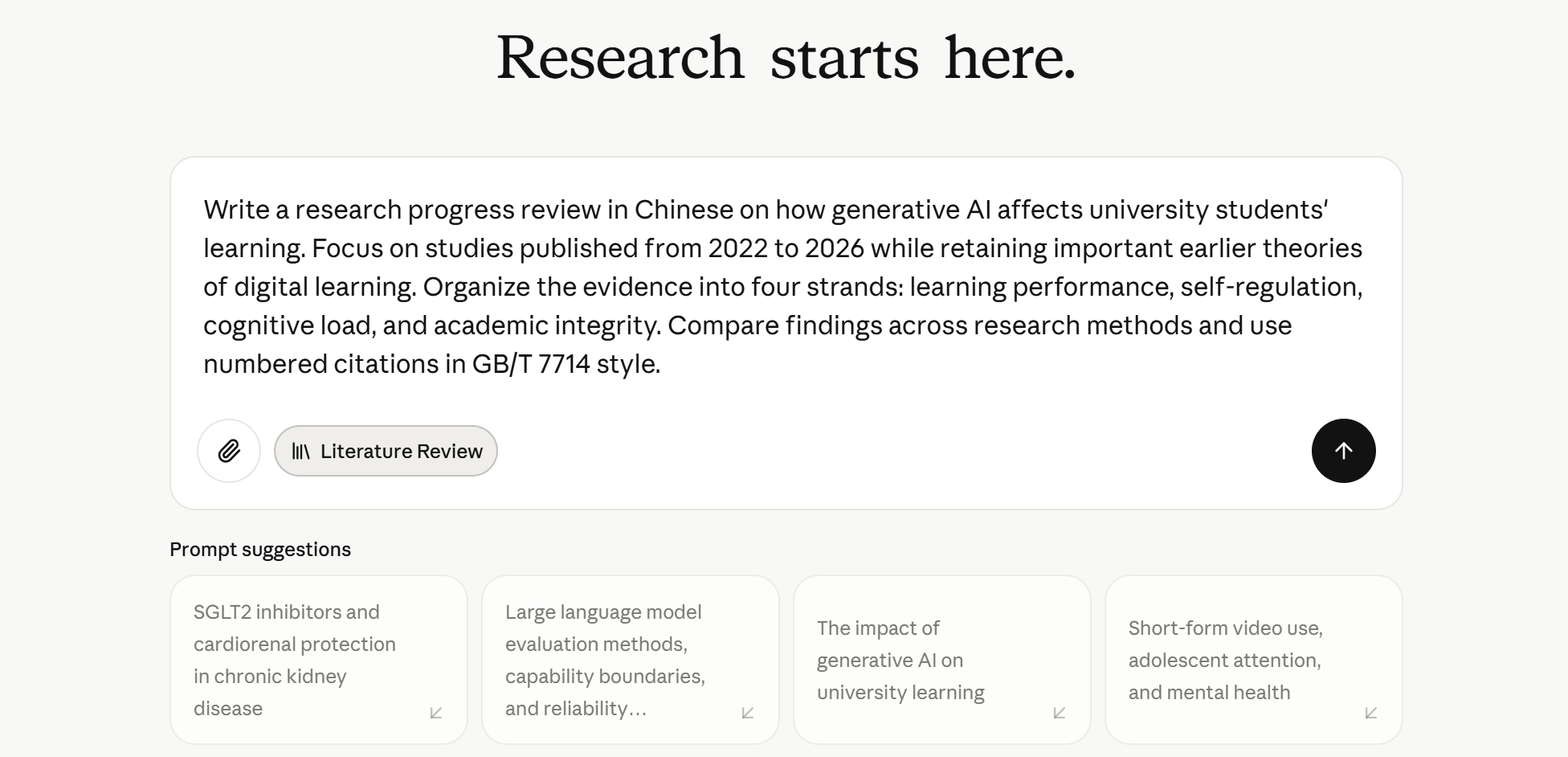
Step 1: Select "Literature Review" and enter your topic
Sign in to Yila and select "Literature Review" on the homepage. The dedicated literature review settings panel will open.
Your input can include:
- Research Topic or Question
- Research Population or Context
- Evidence Distinctions
- Output Language and Citation Style
An appropriately scoped example:
Write a research progress review in English on how generative AI affects university students' learning. Focus on studies published from 2022 to 2026 while retaining important earlier theories of digital learning. Organize the evidence into four strands: learning performance, self-regulation, cognitive load, and academic integrity. Compare findings across research methods and use numbered citations in GB/T 7714 style.
After entering the research topic in the main input box, click Start to proceed.
Step 2: Wait for retrieval and writing to finish
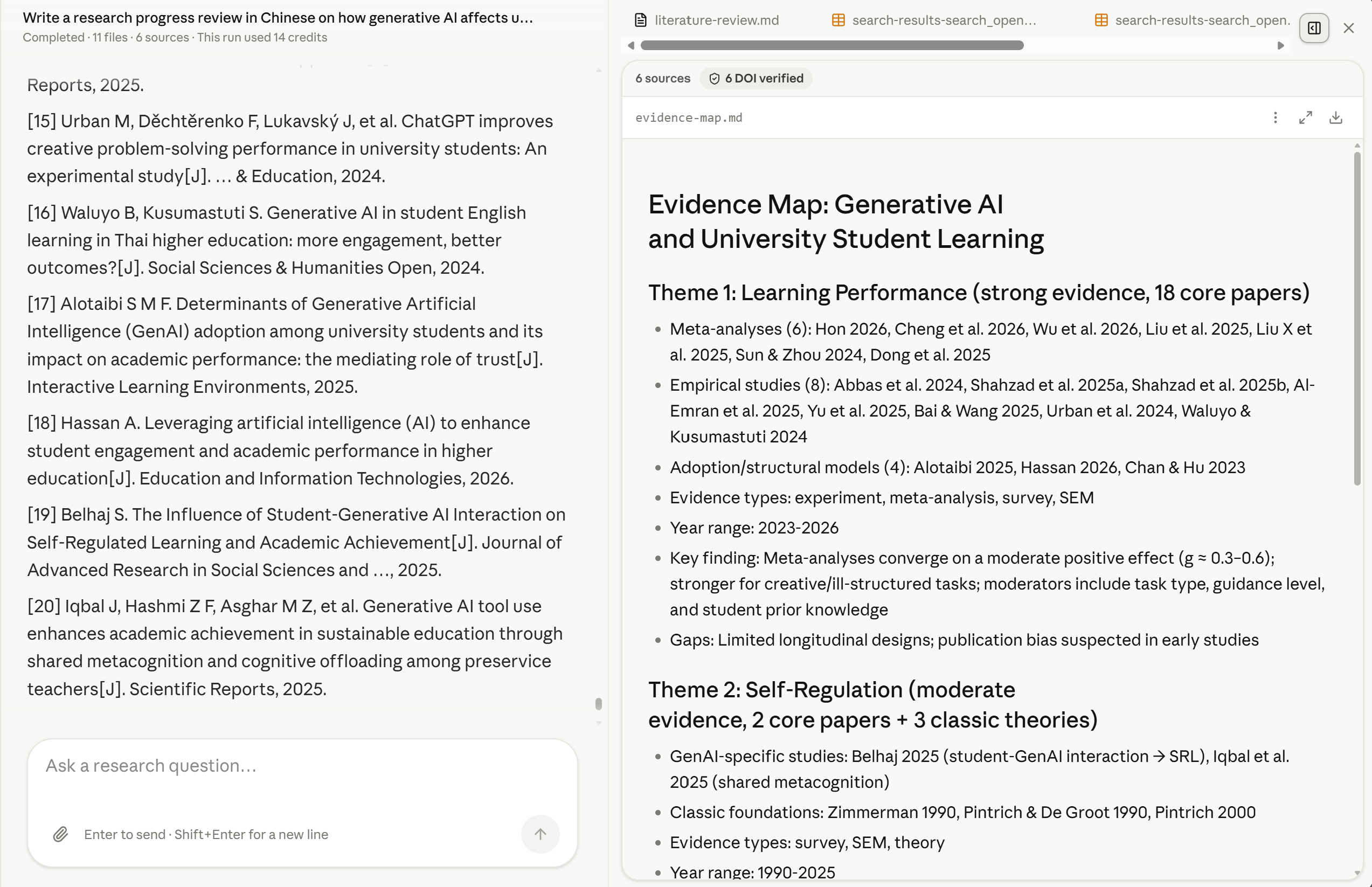
As the task runs, the candidate paper pool, core references, evidence map, and outline will appear progressively on the right. If you select "Complete in One Go," no step-by-step action is required; simply wait for the final review to appear.
Step 3: Read and download the final review
After writing and citation validation are complete, Yila displays the full review in the conversation and saves it as literature-review.md.
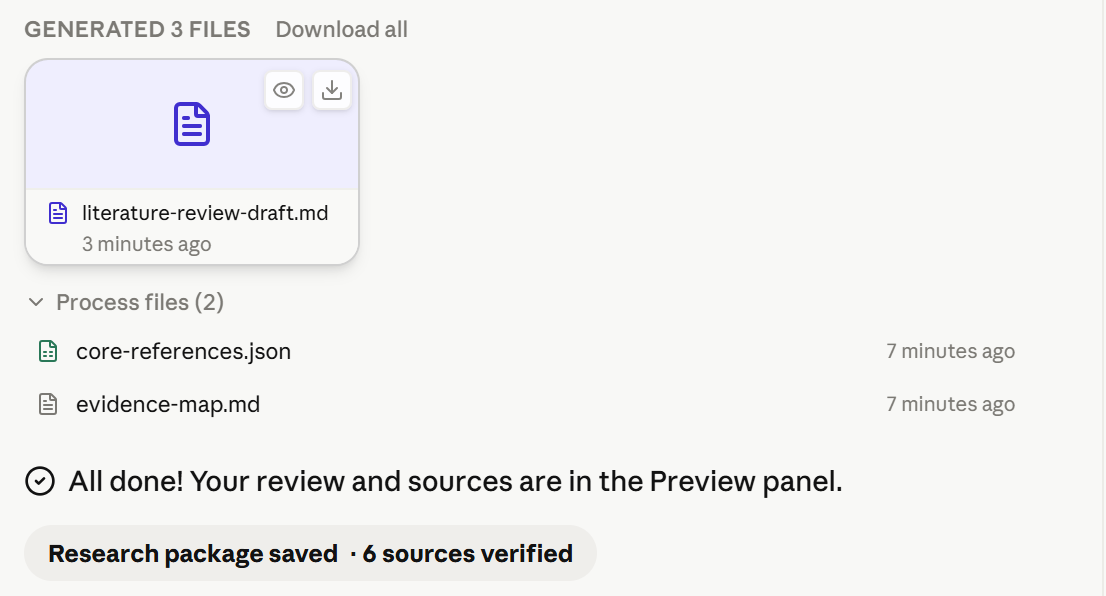
From Deliverables on the right, you can open the review, paper pool, evidence map, and outline. A complete task usually includes:
- candidate-paper-pool.json: the candidate paper pool;
- core-references.json: the selected core references;
- evidence-map.md: the evidence map;
- review-outline.md: the article outline;
literature-review.md: the final review.
How Can You Write Better Task Instructions?
Research Progress Review
Write a research progress review in Chinese on how generative AI affects university students' learning. Focus on 2022-2026 while retaining important digital learning theories. Organize the evidence by learning performance, self-regulation, cognitive load, and academic integrity; compare findings from experiments, surveys, and qualitative studies; use numbered GB/T 7714 citations; and select the standard length.
Biomedical Review
Write a narrative review in Chinese on SGLT2 inhibitors for slowing the progression of chronic kidney disease in adults without diabetes, covering 2019-2026. Distinguish randomized controlled trials, real-world evidence, and mechanistic studies. Explain the consistency of evidence, applicable populations, and unresolved safety questions. Use Vancouver citations.
Chinese Social Sciences Review
Review the theoretical evolution and empirical progress of media convergence research in China from 2015 to 2026, searching both Chinese and international studies. Focus on comparing three explanatory frameworks: technology-driven change, organizational transformation, and public value. Identify the evidential boundaries of different methods and future testable questions. Generate a standard-length review in Chinese.
Review the Outline First
First complete the literature search, core-reference selection, evidence map, and detailed outline. Do not write the main text yet. For each section, the outline should state its central claim, main evidence, and logical relationship to the next section. Wait for my confirmation before continuing.
Revise the Final Draft
Revise the current review: strengthen the comparison between Sections 2 and 3; reduce generic background; organize conflicting evidence into a separate table; and add three testable future research questions to the conclusion. Then revalidate citations in the main text, synthesis table, and reference list.
Core Advantages of Yila Literature Review
1. Search and screen before writing
Yila first builds the candidate paper pool in candidate-paper-pool.json, then selects core references that match the topic and article structure. A standard review typically retains about 40-60 core references instead of relying on only a few highly cited papers.
The screening process considers:
- Direct relevance to the research question;
- Foundational work and recent advances;
- Major reviews, guidelines, and high-quality primary studies;
- Coverage across themes, methods, and evidence types;
- Diversity of sources, author teams, and research programs.
2. Automatically select sources by discipline
Different fields require different combinations of databases. Yila first identifies the discipline and then chooses an appropriate retrieval path:
- Biomedical, clinical, and public health topics: primarily OpenAlex and PubMed;
- Chinese social sciences, domestic policy, media, and education topics: OpenAlex together with Wanfang;
- Computer science, engineering, management, and general interdisciplinary topics: primarily OpenAlex, supplemented with other scholarly sources when a clear coverage gap exists.
This reduces the bias caused by applying the same retrieval strategy to every discipline.
3. Synthesize the field instead of listing papers
A high-quality review needs a central line of argument that organizes the entire article. Based on the evidence, Yila selects a suitable structure, such as:
- Development of the field and paradigm shifts;
- Mechanistic or conceptual frameworks;
- Classification and comparison of methods;
- Theoretical controversies and boundary conditions;
- Practice-based evidence and implementation pathways;
- Interdisciplinary applications and research agendas.
The final review compares and synthesizes themes, mechanisms, controversies, or methods, avoiding a paper-by-paper list of what each author found.
4. Clearly distinguish evidence strength, conflicts, and gaps
Before writing, Yila builds an evidence map that classifies evidence under each theme as strong, mixed, emerging, or weak, while recording gaps in coverage and potential risks. The final text can therefore distinguish honestly among established conclusions, inconsistent findings, and directions that remain understudied, instead of presenting all papers as if they agree.
5. Cite only from a closed set of core references
The final reference list can include only sources saved in the core reference set. Yila checks that citations in the main text, synthesis tables, and reference list are consistent, and verifies traceable identifiers such as DOI, PMID, OpenAlex ID, Wanfang ID, or complete bibliographic information.
This mechanism is designed to reduce:
- Mismatches between in-text citations and the reference list;
- Duplicate numbering of the same paper;
- Citations to papers that are topically similar but do not support the specific claim;
- Nonexistent or incorrect references generated from model memory.
6. Complete in one go or review the outline first
If the research direction is already clear, choose "Complete in One Go." For a complex topic, a thesis, or a project whose structure requires team approval, choose "Review Outline First." Yila completes retrieval and evidence mapping, generates the outline, and pauses for your confirmation before drafting the main text.
Frequently Asked Questions and Additional Notes
1. How should I choose a review type?
- Choose "Auto" if you are unsure.
- Choose "Research Progress Review" to map the development, debates, and trends of a field.
- Choose "Narrative Review" to build an argument around mechanisms, theories, or themes.
- Choose "Scoping Review" to map concepts, study types, and research gaps.
- Choose "Thesis Literature Review" for a proposal or thesis chapter.
- Choose "Systematic Review Draft" when you need a more transparent framework for retrieval, inclusion and exclusion, and synthesis.
A "Systematic Review Draft" cannot replace protocol registration, independent screening by two reviewers, risk-of-bias assessment, or human verification required for formal publication.
2. How should I choose between completing in one go and reviewing the outline first?
Choose "Complete in One Go" for ordinary topics and rapid delivery. For a thesis, grant proposal, interdisciplinary topic, or an established theoretical framework, "Review Outline First" is recommended so you can inspect section logic and evidence coverage before drafting begins.
3. What is the difference between short, standard, and in-depth lengths?
"Short" is suitable for a quick introduction. "Standard" works well for formal coursework, research progress reports, and thesis reviews; Chinese main text is typically about 5,000-8,000 characters. "In-depth" is intended for long reports and near-submission drafts. Additional length should come from comparisons, controversies, mechanisms, and boundary analysis, not repeated background.
4. Which databases does Yila search?
The system automatically selects sources by discipline. Biomedical topics primarily use OpenAlex and PubMed. Chinese social sciences and domestic topics combine OpenAlex and Wanfang. General topics in computer science, engineering, and management usually rely mainly on OpenAlex, with additional sources added when needed.
5. What are the candidate paper pool, core references, and evidence map?
The candidate paper pool contains the initial search results. Core references are the sources selected from that pool as the formal basis for writing. The evidence map organizes those core references by theme, method, year, strength of evidence, and research gap. A standard review usually retains about 40-60 core references.
6. What if the search results drift away from my topic?
Clarify exclusions and additions early in the conversation, for example: "Exclude K-12 studies and add papers on self-regulated learning among university students." It is best to correct the paper pool before the main text is completed.
7. What should I check in the outline?
Check whether the review has a clear central argument, whether each section has enough evidence, whether both consensus and conflict are represented, whether any important topics are missing, and whether the section order advances the argument logically.
8. How should I specify the time range?
You can give exact years, a recent period, or no limit. To balance historical foundations and current work, use: "Retain classic foundational studies and focus on 2020-2026."
9. How should I choose a citation style?
Chinese papers and theses often use GB/T 7714, medicine commonly uses Vancouver, and the social sciences commonly use APA. Always follow the requirements of your institution, supervisor, or target journal.
10. How is a literature review different from a standard literature search?
A literature search primarily delivers a candidate paper pool to help you find and screen papers. A literature review also selects core references, builds an evidence map and article structure, generates an outline, and writes a cited synthesis.
11. Can I upload my own papers or reference list?
Yes. Upload relevant materials and explain how they should be used in the task instructions. However, if you need a formal review that covers the field, you should usually allow Yila to retrieve additional sources so that the evidence base is not too narrow.
12. Why does Yila sometimes ask a scoping question first?
Yila asks only when missing information would materially change retrieval cost, evidence strength, or the form of the output, such as whether to include preprints or require full-text evidence. It does not ask again about settings that are already clear.
13. What is the benefit of reviewing the outline first?
It lets you check the direction of the argument and evidence coverage before long-form writing begins. This is especially useful for theses, grant backgrounds, and interdisciplinary topics. Revising an outline is usually less costly than restructuring a completed review.
14. Can the generated review be submitted directly for publication?
Submitting it without human review is not recommended. Yila can improve the efficiency of retrieval, synthesis, and citation traceability, but authors must still verify the original sources, perform any necessary full-text reading, follow the journal's methodological requirements, and take responsibility for all claims and citations.
15. Does citation validation prove that every research conclusion is correct?
No. Citation validation mainly ensures that citations come from the core reference set, bibliographic information is traceable, numbering and tables are consistent, and the cited source supports the corresponding claim. It cannot replace expert assessment of study methods, bias, and data.
16. Can the Chinese and English guides share the same images?
No. The Chinese guide should use the Chinese interface and a Chinese review. For the English guide, switch to the English interface, choose English output, rerun the task, and take new screenshots. The two image sets should use the same example topic and composition.
17. What should a standard review include?
- A title that expresses the organizing argument;
- An abstract that states the scope, framework, themes, and conclusions;
- An introduction that distinguishes the real-world problem from the literature problem;
- Main sections organized by theme, mechanism, method, or controversy;
- At least one synthesis table with citations;
- Explicit limitations, boundary conditions, and a future research agenda;
- Traceable references whose numbering matches the main text.
Summary
The value of Yila Literature Review is not simply that it helps you write faster. It brings retrieval, screening, evidence organization, article architecture, synthesis, and citation validation together in a single traceable workflow:
Define the research scope -> select the review type and delivery mode -> build the candidate paper pool -> select core references -> create the evidence map and outline -> synthesize and write -> validate citations -> save the final review.
For formal academic writing, the most important practices are to state the research question precisely before starting, carefully inspect the evidence coverage and outline before writing, and continue checking the original sources after generation.